
Boutique Rehab Facility Benefits: What You Gain

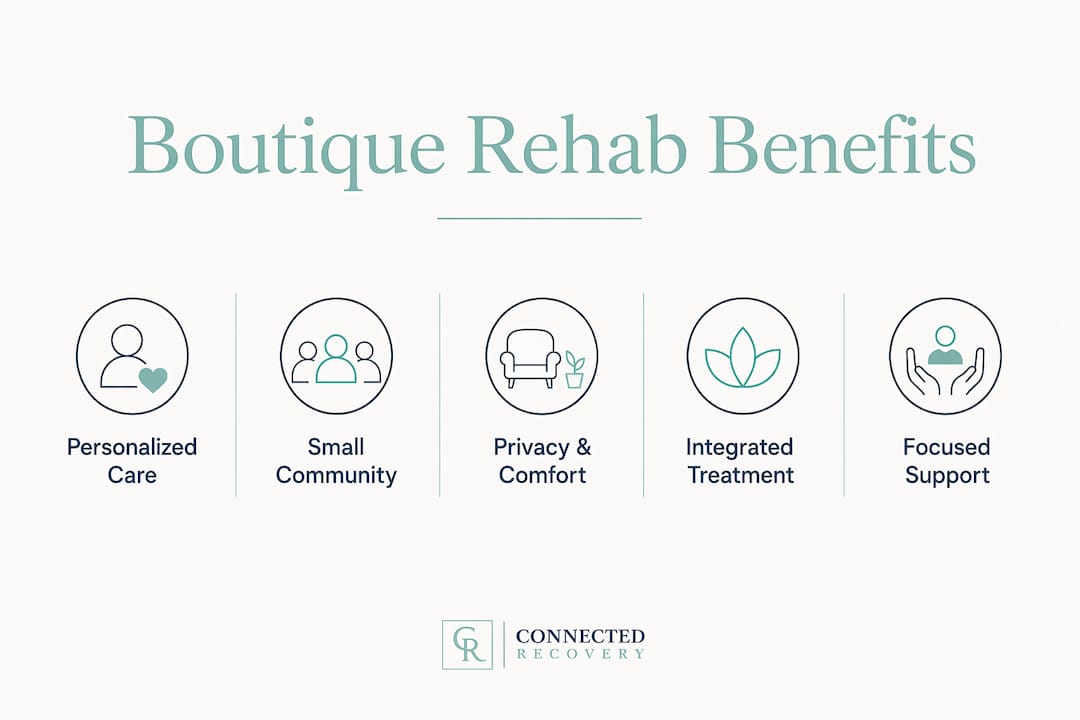
Boutique rehab facilities give you something most large treatment centers structurally cannot: the full attention of a clinical team that actually knows you. With a patient census typically under 15 beds, these facilities run at a staff-to-patient ratio that can reach 3:1 or better, meaning your therapist is not splitting focus across 40 other clients when you need to work through something difficult. The core boutique rehab facility benefits come down to this: smaller scale creates the conditions for real, individualized care.
Here is what that looks like in practice:
- Individualized treatment plans built around your specific history, not a standardized protocol
- Consistent clinical relationships with the same therapist and medical staff throughout your stay
- Smaller therapy groups where you actually get time to speak and be heard
- Privacy and comfort in home-like settings that reduce the institutional anxiety of large centers
- Flexible programming that adjusts as you progress, not on a fixed schedule
- Integrated dual diagnosis care addressing addiction and co-occurring mental health conditions simultaneously
- 24/7 medical supervision tailored to your clinical picture
- Selective admission that keeps the therapeutic community compatible and focused
One honest caveat: boutique facilities are not the right fit for every clinical situation. Cases involving active psychosis, severe eating disorders, or other highly complex medical needs may require the specialist depth that only larger centers can provide.
Table of Contents
- What makes a boutique rehab facility different from a large center?
- How personalized care actually works in a boutique rehab setting
- Privacy, comfort, and the therapeutic community you actually want to be part of
- Why dual diagnosis treatment works better at a smaller scale
- Connected Recovery: what a 12-bed boutique facility looks like in practice
- Connected Recovery is worth a direct conversation
- Key Takeaways
What makes a boutique rehab facility different from a large center?
The term “boutique rehab” refers to a specific structural model, not just a marketing label. These are licensed treatment facilities with a deliberately limited patient capacity, often fewer than 15 beds, designed to prioritize depth of care over volume.
A few defining characteristics set them apart:
- Limited census: The small patient count is the foundation of everything else. It is what makes individualized attention structurally possible rather than aspirational.
- High staff-to-patient ratios: Where a large facility might assign one counselor to a caseload of 15 or 20 clients, boutique programs often maintain ratios of 3:1 or better, giving clinical staff the bandwidth to engage meaningfully with each person.
- Individualized treatment protocols: Intake assessments go deeper, and the resulting treatment plan is genuinely tailored, not a template with a name filled in.
- Home-like physical environments: Most boutique facilities are designed to feel residential rather than institutional. Private or semi-private rooms, comfortable common areas, and natural settings all reduce the ambient stress that can undermine early recovery.
- Selective admission policies: Many boutique programs screen for clinical appropriateness and group compatibility. This is not exclusivity for its own sake. Selective admission preserves the therapeutic environment and keeps the peer community cohesive.
- Specialized therapy offerings: Boutique settings frequently incorporate evidence-based modalities like Cognitive Behavioral Therapy and Dialectical Behavior Therapy alongside adjunctive approaches such as mindfulness, somatic work, trauma-focused therapy, or art therapy, all selected based on individual clinical need.
The contrast with volume-based care is not about amenities. It is about how clinical resources are allocated. When a facility is built to treat 80 people at once, standardization is a practical necessity. Boutique programs are built around the opposite assumption.
How personalized care actually works in a boutique rehab setting
Personalized care is one of those phrases that gets used so broadly it starts to lose meaning. In a boutique rehab, it has a specific clinical structure behind it.
Treatment planning begins at intake with a thorough biopsychosocial assessment covering substance use history, mental health background, trauma, family dynamics, and personal goals. That assessment drives a treatment plan that is genuinely specific to you, including which therapy modalities you will engage with, how frequently, and in what format. Individual therapy sessions are more frequent than in larger programs, and the therapist delivering them is typically the same person throughout your stay.
- Consistent therapeutic relationships: The therapeutic alliance formed through sustained contact with the same clinician is one of the strongest predictors of long-term sobriety and treatment retention. In large centers, staff turnover and caseload size often disrupt that continuity.
- Accessible clinical staff: In a boutique setting, your therapist is reachable. You are not waiting days for a scheduled slot when something comes up.
- Smaller group therapy: Groups of 4–8 people give each participant substantially more speaking time, build trust faster, and produce higher engagement than groups of 15 or 20. Research supports that smaller therapy groups lead to better retention.
- Adaptive programming: If a particular approach is not working, a boutique team can adjust quickly. There is no bureaucratic lag between clinical observation and treatment modification.
- Transparency in staffing: Knowing who is on your care team, what their credentials are, and what role each person plays reduces confusion and builds trust. Boutique programs tend to be clearer about this than larger institutional settings.
The benefits of individualized addiction treatment extend beyond comfort. When treatment is built around your specific clinical profile, you are more likely to stay engaged, complete the program, and carry the skills you develop into long-term recovery.
Privacy, comfort, and the therapeutic community you actually want to be part of

The physical and social environment of a rehab facility is not a secondary concern. It directly affects whether clients engage fully with treatment or hold back.
Boutique rehab environments are designed for comfort and privacy, which reduces social anxiety and creates the conditions for deeper participation. When you are not sharing a room with three strangers or navigating a cafeteria line with 60 other people, the cognitive and emotional load of early recovery drops significantly.
The community aspect matters just as much. In a group of 10 or 12 people, you actually get to know your peers. You learn their stories. You notice when someone is struggling. That kind of mutual accountability and genuine connection is harder to build in a large center where the faces change regularly and group sessions feel more like lectures than conversations.

Pro Tip: If social anxiety is part of your clinical picture, ask any facility you are considering about their average group size for therapy sessions. A group of 5–8 is meaningfully different from a group of 20, both clinically and experientially.
A few specific advantages worth noting:
- Privacy and dignity: Boutique facilities typically offer private or semi-private accommodations, protecting confidentiality in a way that matters especially for professionals, executives, or anyone with public visibility.
- Reduced social overwhelm: Smaller peer groups lower the threshold for participation, particularly for clients with trauma histories or social anxiety.
- Stronger sense of belonging: Consistent contact with the same small group of peers builds real community, which is a meaningful protective factor in early recovery.
- Serene, home-like settings: Natural light, comfortable furnishings, and calm surroundings are not luxury extras. They lower cortisol, reduce hypervigilance, and make the hard work of therapy more accessible.
For clients exploring couples therapy in San Diego or other relationship-focused work alongside addiction treatment, the intimate setting of a boutique program also makes it easier to integrate that kind of specialized support into the overall plan.
Why dual diagnosis treatment works better at a smaller scale
Addiction rarely travels alone. A significant portion of people seeking treatment have a co-occurring mental health condition, whether depression, anxiety, PTSD, bipolar disorder, or something else. Treating only the substance use while leaving the underlying mental health condition unaddressed is one of the most common reasons people relapse.
Boutique rehabs are well-positioned to handle dual diagnosis treatment because the integrated care model is easier to execute at a smaller scale. Here is why:
- Personalized psychiatric assessment: Each client receives a thorough psychiatric evaluation at intake, not a brief screening. That assessment informs both the addiction treatment plan and any psychiatric medication management.
- Collaborative care teams: In a boutique setting, the psychiatrist, therapist, and medical staff are working from the same clinical picture and communicating regularly. That coordination is harder to maintain in large facilities where departments can operate in silos.
- 24/7 medical supervision: Round-the-clock oversight means psychiatric symptoms are monitored continuously, not just during scheduled appointments. Medication adjustments happen faster, and crises are caught earlier.
- Consistent clinical team: When the same clinician tracks your mental health across weeks of treatment, they notice subtle changes. That continuity is clinically significant.
- Integrated therapy modalities: Boutique programs can incorporate trauma-focused approaches, DBT skills groups, and psychiatric care within a single cohesive treatment plan rather than treating addiction and mental health as parallel but separate tracks.
One important limitation: boutique facilities are not equipped for every psychiatric presentation. Cases involving active psychosis, severe eating disorders requiring medical stabilization, or other highly complex co-morbidities typically need the specialist depth of a larger center with multiple psychiatrists and subspecialty staff. The right setting depends on the clinical picture, and an honest boutique program will tell you directly if your needs exceed their scope.
Connected Recovery: what a 12-bed boutique facility looks like in practice
Connected Recovery is a 12-bed boutique facility in Van Nuys, California, built specifically around the model described throughout this article. The capacity is not a limitation; it is the clinical design. With 12 beds, the staff-to-patient ratio stays high enough that individualized attention is not a selling point but a structural reality.
The care model runs from medical detox through residential treatment and into aftercare planning, meaning clients do not have to navigate a handoff between disconnected providers at each stage of recovery. That continuity matters clinically. The same team that manages your detox is involved in your residential programming and your discharge planning.
Key features of the Connected Recovery model:
- 24/7 medical supervision throughout detox and residential treatment, with clinical staff available around the clock
- Integrated dual diagnosis care addressing substance use and co-occurring mental health conditions within a single treatment framework
- Individualized treatment plans developed from thorough intake assessments and adjusted as treatment progresses
- Aftercare planning built into the program from early on, not added as an afterthought at discharge
- Consistent clinical team maintaining therapeutic relationships across the full length of stay
- Published educational resources supporting patient understanding of treatment options and recovery processes
Connected Recovery treats both drug addiction and co-occurring mental health disorders, with a clinical approach grounded in evidence-based practice. The 12-bed model means the clinical team genuinely knows each client, which is the foundation of everything else the program delivers.
Connected Recovery is worth a direct conversation
If the boutique rehab model fits what you are looking for, Connected Recovery is a strong place to start. The 12-bed capacity means you will not be processed through a system built for volume. You will have a clinical team that knows your name, your history, and your goals from day one.
The program covers the full continuum: medically supervised detox, residential treatment, dual diagnosis care, and structured aftercare planning. That is not common in boutique settings, where some programs handle only one phase and refer out for the rest. Connected Recovery keeps the clinical relationship intact across every stage, which is where a lot of the real therapeutic value lives.
If you are weighing your options, reach out to Connected Recovery directly to discuss your clinical situation, ask about program fit, and get a clear picture of what the treatment experience looks like. The addiction treatment programs page is a good starting point, and the clinical team is available to answer specific questions about whether the boutique model is right for your needs.
Key Takeaways
Boutique rehab facilities deliver meaningfully better individualized care than large centers for the right clinical candidate, with smaller patient census and higher staff ratios as the structural foundation.
| Point | Details |
|---|---|
| Small census drives real individualization | Facilities with fewer than 15 beds can build treatment plans that are genuinely specific to each client. |
| Staff ratios reach 3:1 or better | Higher staff-to-patient ratios mean more clinical contact, stronger therapeutic alliances, and faster treatment adjustments. |
| Smaller groups improve retention | Therapy groups of 4–8 people build trust faster and produce higher retention than larger group formats. |
| Dual diagnosis care integrates more cleanly | Boutique teams coordinate psychiatric and addiction care within a single clinical framework, with 24/7 medical supervision. |
| Connected Recovery offers the full continuum | The 12-bed Van Nuys facility covers detox, residential treatment, dual diagnosis care, and aftercare planning under one consistent clinical team. |
Recommended
DHCS Licensed · Joint Commission Accredited
If you or a loved one is struggling with substance use, our admissions team is available to verify your insurance benefits and help you begin recovery. All calls are confidential.