
The Role of Exercise Recovery in Fitness and Performance

Exercise recovery is defined as the phase after physical training where your body repairs damaged tissue, restores energy stores, and adapts to become stronger. This process is not passive downtime. It is where actual fitness gains occur. The American College of Sports Medicine (ACSM) confirms that restoring homeostasis and repairing tissues are the primary goals of post-exercise recovery. Without this phase, training stress accumulates without the adaptation that makes it worthwhile. Understanding what is the role of exercise recovery gives you a direct edge in building strength, preventing injury, and sustaining long-term performance.
What is the role of exercise recovery in the body?
Progress happens during recovery, not during exercise itself. When you train, you create controlled stress: micro tears in muscle fibers, depleted glycogen, and elevated metabolic waste. The body then rebuilds and adapts during rest, producing muscle that is denser and more resilient than before. Skip recovery, and you are simply accumulating damage without the repair cycle that converts effort into results.
The physiological processes involved in recovery are specific and well-documented. Your nervous system must shift from sympathetic “fight or flight” dominance into the parasympathetic “rest and digest” state. Chronic sympathetic activation, the kind caused by overtraining or chronic stress, blocks tissue repair and disrupts hormonal balance. This is why two athletes doing identical workouts can get very different results based solely on how well they recover.
What happens during deep sleep and rest
Deep sleep is the body’s primary repair window. During deep sleep, the body repairs micro muscle tears, balances hormones including growth hormone and cortisol, and consolidates motor memory from training sessions. Healthy adults aged 18–64 need 7–9 hours of sleep per night to support this process fully. That recommendation comes from the 2025 Australian 24-hour movement guidelines and aligns with ACSM guidance. Falling short of that range consistently means your muscles are never fully repaired before the next training session.

Blood circulation also plays a critical role during recovery. The body uses increased blood flow to deliver nutrients to damaged muscle fibers and remove metabolic waste products like lactate and hydrogen ions. Elevated cortisol from overtraining impairs this process, blocking tissue repair and raising injury risk. The result is a performance plateau that no amount of additional training can break through.
What are the benefits of exercise recovery for fitness?
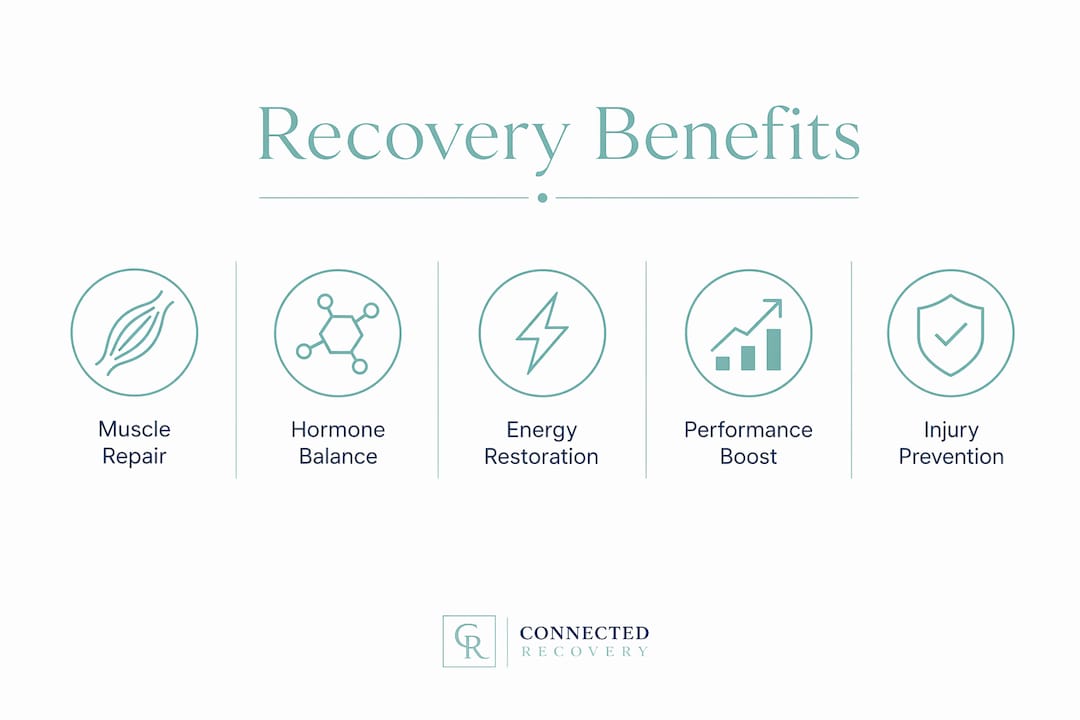
Effective recovery produces measurable benefits across multiple dimensions of fitness and health.
- Muscle growth and strength adaptation. Muscles do not grow during the workout. They grow during the repair phase that follows. Consistent recovery allows progressive overload to translate into actual size and strength gains.
- Injury prevention. Without adequate recovery, athletes face overuse injuries, performance plateaus, and hormonal imbalances that hinder muscle growth and insulin sensitivity. Rest days are not a sign of weakness. They are a structural requirement.
- Reduced delayed onset muscle soreness (DOMS). DOMS peaks 24–72 hours after training. Proper recovery techniques reduce its severity and duration, letting you train again sooner and with better form.
- Better hormonal regulation. Recovery restores the cortisol-to-testosterone ratio that drives muscle building. Chronic overtraining keeps cortisol elevated and suppresses anabolic hormones, reversing the effect of training.
- Improved insulin sensitivity. Glycogen replenishment during recovery improves how efficiently your muscles absorb glucose. This has direct benefits for body composition and metabolic health.
- Psychological benefits. Burnout and training fatigue are real. Scheduled recovery reduces mental fatigue, restores motivation, and keeps training sustainable over months and years rather than weeks.
The importance of recovery in fitness is not limited to elite athletes. Recreational exercisers who skip rest days consistently report higher rates of injury and lower long-term adherence to training programs.
Which exercise recovery techniques does research support?
Not all recovery methods are equal. Research published in Frontiers in Physiology in 2025 compared five major recovery interventions and found that massage and cold-water immersion positively modulate fatigue and inflammation. Static stretching, by contrast, shows no significant physiological benefit for clearing metabolic waste and may transiently reduce muscle force production. That finding contradicts decades of gym-floor advice.
| Technique | Primary benefit | Key limitation |
|---|---|---|
| Active recovery (6–10 min light movement) | Boosts blood flow, clears metabolic waste | Loses benefit if duration or intensity exceeds threshold |
| Massage therapy | Reduces CNS fatigue and inflammation | Requires access to therapist or quality device |
| Cold-water immersion | Controls acute inflammation | May blunt long-term muscle adaptation if overused |
| Static stretching | Improves flexibility | No meaningful benefit for metabolic recovery |
| Nutrition and hydration | Restores glycogen and supports repair | Timing and composition matter significantly |
Active recovery: the most accessible technique
Active recovery is the most practical tool available to most people. Just 6–10 minutes of low-intensity movement after intense exercise boosts blood circulation and facilitates removal of metabolic waste, accelerating the recovery process. A slow walk, light cycling, or easy swimming all qualify. The key constraint is intensity and duration. Exceeding 10 minutes or raising intensity too high converts recovery movement into additional training, eliminating the benefit entirely.
Pro Tip: Set a timer for 8 minutes after your last hard set. Walk or pedal at a pace where you can hold a conversation easily. Stop when the timer ends. That window is the sweet spot for metabolic clearance without adding training stress.
Nutrition timing as a recovery strategy
Nutrition is a recovery technique, not just a general health habit. Timed protein and carbohydrate intake following workouts enhances muscle repair and glycogen replenishment. The practical application is straightforward: consume a meal or snack containing both protein and carbohydrates within 30–60 minutes of finishing a workout. Hydration is equally critical, particularly as people age, since older adults experience a blunted thirst response and are more prone to dehydration-driven recovery impairment.
How to recover after exercise: building it into your routine
Knowing the techniques matters less than actually scheduling them. Recovery strategies for workouts need to be planned with the same intention as training sessions.
- Schedule rest days and active recovery days separately. A rest day means no structured training. An active recovery day means 20–30 minutes of very light movement. Treat both as non-negotiable appointments.
- Protect your sleep window. Aim for 7–9 hours of consistent sleep each night. Consistency matters as much as duration. Going to bed and waking at the same time daily stabilizes the hormonal cycles that drive tissue repair.
- Eat within the post-workout window. Prioritize a protein and carbohydrate combination within 60 minutes of finishing exercise. A well-rounded recovery approach integrating nutrition, hydration, active recovery, and quality sleep yields sustained physical activity benefits and injury prevention.
- Use cold or heat therapy strategically. Cold-water immersion works best for acute inflammation control after high-intensity sessions. Heat therapy improves blood flow and is better suited to rest days or lower-intensity recovery days.
- Monitor your body’s signals. Persistent soreness lasting more than 72 hours, declining performance across sessions, disrupted sleep, and irritability are all signs of insufficient recovery. Adjust training volume before adding more recovery tools.
- Invest in a quality massage tool. Percussion massage devices deliver many of the same CNS fatigue and inflammation benefits as manual massage therapy. Used for 5–10 minutes on target muscle groups after training, they are a practical daily option.
Pro Tip: Track your resting heart rate each morning before getting out of bed. A reading 5–7 beats above your normal baseline is a reliable early warning sign of under-recovery. Reduce training intensity that day rather than pushing through.
For a deeper look at how recovery principles apply beyond the gym, the holistic recovery guide at Connected Recovery covers the broader science of sustainable recovery across physical and mental health.
Key Takeaways
Exercise recovery is the phase where fitness gains are actually built, and skipping it converts training stress into injury risk rather than strength.
| Point | Details |
|---|---|
| Recovery drives adaptation | Muscle repair and growth happen during rest, not during the workout itself. |
| Sleep is the primary repair window | Adults need 7–9 hours nightly for full hormonal balance and tissue repair. |
| Active recovery has a strict window | 6–10 minutes of light movement clears metabolic waste without adding training stress. |
| Massage and cold water beat stretching | Research shows these two techniques outperform static stretching for physiological recovery. |
| Nutrition timing accelerates repair | Protein and carbohydrates consumed within 60 minutes post-workout speed glycogen and muscle recovery. |
Why most people get recovery completely backwards
The most common mistake I see is treating recovery as what happens when you are not training. People plan their workouts down to the set and rep, then leave recovery entirely to chance. That approach guarantees a ceiling on progress.
The real shift is recognizing that training is the stimulus and recovery is the response. You cannot control how strong you get by adding more training. You control it by managing how completely you recover between sessions. I have seen people cut their weekly training volume by 20% and make faster strength gains simply by protecting their sleep and adding 8 minutes of active recovery after each session.
The other mistake is treating all recovery tools as interchangeable. Static stretching feels productive, so people do it. But the evidence is clear: it does not clear metabolic waste, and it may temporarily reduce force output. Massage and cold-water immersion are less comfortable and less convenient, which is probably why they are underused despite being more effective.
The sustainable recovery principles that apply to long-term health apply here too. Sleep, nutrition, movement quality, and stress management are not separate pillars. They interact. Neglect one and the others compensate less than you expect.
Recovery is not a reward for hard training. It is the mechanism that makes hard training worth doing.
— Jim
Recovery support at Connected Recovery
Physical recovery and whole-person wellness share the same foundation: structured rest, proper nutrition, and consistent support systems. Connected Recovery Inc. applies these same principles in its 12-bed boutique facility in Van Nuys, CA, where every client receives a personalized treatment plan built around their specific needs.

The facility’s addiction treatment programs integrate 24/7 medical supervision with mental health support, addressing both substance use and co-occurring conditions in a setting designed for genuine, lasting recovery. If you or someone you care about needs structured support to rebuild physical and mental health, Connected Recovery offers the individualized attention that larger facilities rarely provide.
FAQ
What is the role of exercise recovery in muscle growth?
Exercise recovery is the phase where muscle fibers damaged during training are repaired and rebuilt stronger. Without adequate rest, the repair cycle cannot complete, and muscle growth stalls.
How many rest days per week does a person need?
Most fitness guidelines recommend 1–2 full rest days per week, with additional active recovery days depending on training intensity. The right number depends on training volume, age, and individual recovery capacity.
Does static stretching help with recovery after exercise?
Research published in Frontiers in Physiology in 2025 found that static stretching provides no significant physiological benefit for clearing metabolic waste after exercise. Massage and cold-water immersion are more effective for reducing fatigue and inflammation.
What should you eat after a workout to support recovery?
ACSM guidance recommends consuming both protein and carbohydrates within 30–60 minutes after exercise. This combination accelerates glycogen replenishment and muscle repair more effectively than either macronutrient alone.
How does sleep affect exercise recovery?
Deep sleep is the body’s primary window for repairing micro muscle tears and balancing hormones like growth hormone and cortisol. Adults aged 18–64 need 7–9 hours of quality sleep per night to support full recovery between training sessions.
Recommended
DHCS Licensed · Joint Commission Accredited
If you or a loved one is struggling with substance use, our admissions team is available to verify your insurance benefits and help you begin recovery. All calls are confidential.