
What Is a Recovery Treatment Plan? Your 2026 Guide

A recovery treatment plan is a written, collaborative document that maps out a person’s specific problems, measurable goals, and targeted interventions for addiction or mental health recovery. Clinicians and clients build it together, making it a living roadmap rather than a static form. The SMART framework (Specific, Measurable, Achievable, Relevant, Time-bound) governs how objectives are written, and treatment plans also satisfy insurance requirements, licensing boards, and court evaluations. Understanding what a recovery treatment plan is gives you the foundation to engage meaningfully with your own care.
What is a recovery treatment plan and why does it matter?
A recovery treatment plan is the clinical backbone of any serious addiction or mental health program. Without one, care becomes reactive and directionless. With one, every session, every medication decision, and every milestone connects to a clear purpose.
The plan documents the “why” behind each intervention. A person entering drug addiction treatment may have overlapping problems: opioid dependence, depression, and unstable housing. A well-built plan names each problem separately, assigns goals to each, and links specific interventions to those goals. Nothing is left vague.
Treatment plans also carry legal and regulatory weight. Plans document medical necessity and treatment quality for insurance companies, licensing boards, and courts. That dual function, clinical and administrative, is why every accredited facility requires one from day one.
What are the key components of a recovery treatment plan?
Every effective plan shares the same core architecture, regardless of whether the focus is substance use, mental health, or both.
Problem statements
The plan starts with a clear, specific problem statement written in the client’s own language where possible. Using client language in problem statements prevents disconnection between what the client experiences and what the clinician documents. A vague problem like “substance use issues” is far less useful than “daily alcohol use causing job loss and relationship breakdown.”
Goals and objectives
Goals are broad, long-term targets: “Achieve and maintain sobriety.” Objectives are the measurable steps that get there. Each problem should have 2–4 measurable objectives tied to it, written using SMART criteria. An example objective: “Client will attend three AA meetings per week for 30 days.” That is specific, measurable, and time-bound.
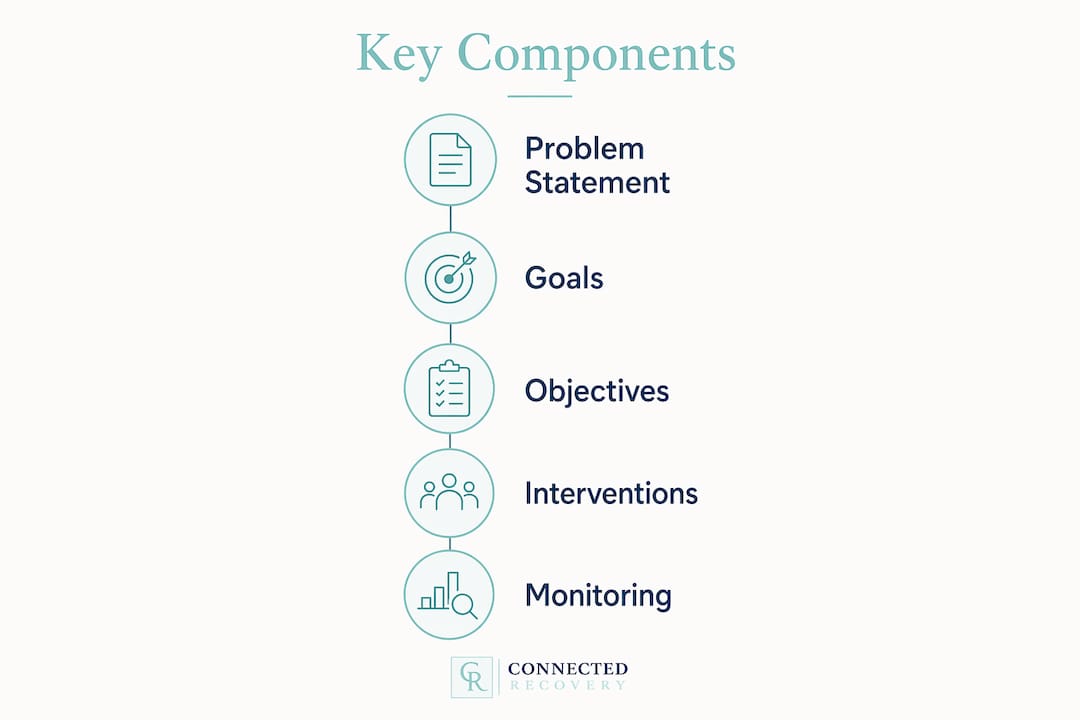
Interventions
Interventions are the specific actions the treatment team takes to help the client reach each objective. These include individual therapy, group counseling, medication-assisted treatment, and case management. Every intervention must connect directly to an objective. A mismatch here creates what clinicians call treatment drift, where sessions happen but recovery stalls.

Additional components
Beyond the core structure, a complete plan includes:
- Strengths and resources: Skills, relationships, and past successes the client brings to recovery
- Barriers: Practical or psychological obstacles that could slow progress
- Crisis and safety plan: Proactive steps for managing relapse risk or acute distress
- Review schedule: Objectives reviewed every 30–90 days depending on care intensity
- Client signature: Verifies participation and strengthens the therapeutic alliance
| Component | Purpose |
|---|---|
| Problem statement | Names the specific issue driving treatment |
| Goals | Sets the long-term recovery target |
| Objectives | Defines measurable steps using SMART criteria |
| Interventions | Lists clinical actions tied to each objective |
| Crisis plan | Prepares client and team for high-risk moments |
How to create an effective recovery treatment plan
Creating a strong plan follows a clear sequence. Skipping steps or rushing the process produces plans that look complete on paper but fail in practice.
- Conduct a thorough assessment. Gather information on substance use history, mental health diagnoses, medical needs, living situation, and social support. This assessment drives every decision that follows.
- Identify specific problems. Translate assessment findings into named, concrete problems. Each problem becomes its own section of the plan.
- Set goals collaboratively. Sit with the client and agree on what recovery looks like for them. Plans created with clients, not imposed on them, produce stronger engagement and accountability.
- Write SMART objectives. For each goal, write 2–4 objectives that are specific, measurable, achievable, relevant, and time-bound. Avoid vague language like “will improve coping skills.” Instead: “will practice one grounding technique daily for four weeks.”
- Select aligned interventions. Match each intervention to a specific objective. This logical connection, often called the “golden thread,” prevents treatment drift and keeps care on track.
- Document strengths and aspirations. A strengths-based approach increases client motivation and makes the plan feel relevant rather than clinical.
- Schedule regular reviews. Build review dates into the plan from the start. Plans that are never updated become obstacles rather than tools.
Pro Tip: Ask the client to describe what a good week looks like for them. That answer often reveals the most meaningful goals and makes the plan feel personal rather than procedural.
What challenges affect recovery treatment plans?
The biggest misconception about treatment plans is that they are paperwork. Clinicians who treat them as administrative tasks produce plans that sit in a file and do nothing. Treatment plans are therapeutic tools whose effectiveness depends entirely on collaboration and regular use.
“A treatment plan that is never revisited is not a plan. It is a record of good intentions.”
Treatment drift is the most common clinical failure. It happens when goals, objectives, and interventions lose their logical connection over time. A client may be attending sessions consistently, but if those sessions no longer address the documented problems, progress stalls. Disconnections in treatment plans lead to unclear purpose and stalled recovery.
Other challenges include:
- Low client engagement: Clients who did not participate in building the plan feel no ownership over it. Participation from the first session changes that dynamic.
- Missing crisis plans: Failure to address crisis needs within the plan can lead to relapse or acute setbacks. A crisis plan is not optional for anyone with a history of relapse or self-harm.
- Static plans: Failing to review and adjust plans is a leading cause of treatment stagnation. Recovery changes, and the plan must change with it.
- Vague objectives: Objectives that cannot be measured cannot be evaluated. If you cannot tell whether an objective was met, it was written incorrectly.
How are recovery treatment plans applied in real-world recovery?
A plan on paper only becomes useful when it guides real decisions across the full arc of care. At Connected Recovery, the plan begins at intake and evolves through every stage: medical detox, residential treatment, and beyond.
During detox and residential care
In the early stages, the plan focuses on stabilization. Objectives center on completing detox safely, managing withdrawal symptoms, and beginning to build trust with the treatment team. Residential treatment provides the structured environment where intensive plan work happens daily.
Monitoring progress with validated tools
Clinical intuition alone is not enough to track recovery. Regular monitoring using validated tools provides objective data that holds both clinicians and clients accountable. Standardized measures like the PHQ-9 for depression or the AUDIT for alcohol use give concrete numbers to track over time.
Multidisciplinary coordination
Effective plans require coordination across the care team. Physicians, therapists, case managers, and peer support specialists all work from the same document. Case management services play a central role in keeping that coordination consistent, especially when clients have complex needs like dual diagnosis.
Extending the plan into aftercare
The plan does not end at discharge. Aftercare planning and relapse prevention services extend the plan’s logic into the months after formal treatment ends. Clients who leave with a clear aftercare plan are far better positioned to maintain the gains they made in residential care.
Pro Tip: Ask your treatment team to walk you through your plan at every review. If you cannot explain your own goals and objectives in plain language, the plan needs to be rewritten.
Key takeaways
A recovery treatment plan is only as effective as the collaboration and consistency behind it. The most successful plans are built with the client, updated regularly, and connected by a clear logical thread from problem to intervention.
| Point | Details |
|---|---|
| Definition matters | A recovery treatment plan is a written, collaborative roadmap linking problems, goals, and interventions. |
| SMART objectives are required | Each problem needs 2–4 measurable, time-bound objectives reviewed every 30–90 days. |
| Collaboration drives outcomes | Plans built with clients, not imposed on them, produce stronger engagement and accountability. |
| Crisis plans are non-negotiable | Every plan must include proactive steps for managing relapse risk and acute distress. |
| Plans must evolve | Failing to update a treatment plan is a leading cause of stalled recovery progress. |
Why treatment plans changed how I think about recovery
The first time I sat with someone who had never seen their own treatment plan, I understood the real problem. The plan existed. It was filed correctly. The clinician had checked every box. But the client had no idea what their goals were or why they were attending group therapy three times a week.
That experience reshaped how I think about what is treatment planning at its core. A plan that lives only in a chart is not a clinical tool. It is a liability document. The therapeutic value comes entirely from the client knowing it, owning it, and seeing themselves in it.
The most effective plans I have encountered share one quality: the client can describe their own objectives without looking at the paper. That level of ownership does not happen by accident. It requires clinicians who ask real questions, listen to the answers, and write plans that reflect what the client actually said.
Clients often ask me whether they should push back if their plan feels wrong. My answer is always yes. Individualized treatment means the plan fits you, not the other way around. If your objectives feel irrelevant or your goals feel borrowed from someone else’s recovery, say so. A good clinician will revise the plan. A great one will thank you for it.
— Jim
Connected Recovery’s approach to personalized treatment planning
Connected Recovery operates as a 12-bed boutique facility in Van Nuys, CA, built specifically for people who need close, individualized attention during detox and residential care. Every client receives a treatment plan developed with their direct input, covering substance use, co-occurring mental health conditions, and long-term recovery goals.
Programs at Connected Recovery span medical detox, residential treatment, dual diagnosis care, relapse prevention, and aftercare planning. The small facility size means 24/7 medical supervision and a care team that knows each client by name, not by bed number. If you are ready to build a recovery plan that actually reflects your life and your goals, Connected Recovery’s addiction treatment programs are a strong place to start.
FAQ
What is a recovery treatment plan in simple terms?
A recovery treatment plan is a written document that names your specific problems, sets clear recovery goals, and outlines the steps your care team will take to help you reach them. It is built collaboratively between you and your clinicians.
How often should a treatment plan be updated?
Treatment plan objectives should be reviewed every 30–90 days depending on the intensity of care. Plans must be updated whenever significant progress, setbacks, or changes in circumstances occur.
What happens if I disagree with my treatment plan?
You have the right to discuss and request changes to your plan. Client signatures on treatment plans verify participation, and your input is a required part of the process, not an optional add-on.
What is the difference between a goal and an objective in a treatment plan?
A goal is a broad, long-term target such as achieving sobriety. An objective is a specific, measurable step toward that goal, written using SMART criteria, with a clear timeline attached.
Do treatment plans cover mental health and addiction together?
Yes. Plans for people with co-occurring disorders address both substance use and mental health problems as separate, linked sections. Dual diagnosis treatment requires this integrated approach to avoid treating one condition while ignoring the other.
Recommended
DHCS Licensed · Joint Commission Accredited
If you or a loved one is struggling with substance use, our admissions team is available to verify your insurance benefits and help you begin recovery. All calls are confidential.