
What Is Medical Detoxification: A Clear Guide

Medical detoxification is the 24/7 clinically supervised process of managing acute withdrawal from substances like alcohol, opioids, and benzodiazepines to prevent life-threatening complications. Without medical oversight, withdrawal from alcohol or benzodiazepines can trigger fatal grand mal seizures or delirium tremens. Detox is not addiction treatment. It is the first, critical step that stabilizes you physically so that real recovery work can begin. FDA-approved medications, symptom-scoring tools like CIWA-Ar and COWS, and round-the-clock clinical teams make modern medical detox far safer than any attempt to stop alone.
What is medical detoxification and how does the process work?
Medical detoxification, often called medically supervised withdrawal, follows a structured clinical protocol from the moment you arrive. A physician or nurse practitioner conducts an intake assessment covering your substance use history, current health status, and any co-occurring mental health conditions. That assessment drives every decision that follows.
Clinicians then monitor you continuously using validated symptom-scoring tools. The CIWA-Ar and COWS scales are assessed every 2–4 hours to measure withdrawal severity and adjust medication doses in real time. This frequent scoring is what separates medical detox from any other approach. It removes guesswork and keeps your symptoms within a manageable range.
The medical detox process typically involves:
- Intake and assessment: Medical history, substance use timeline, and mental health screening
- Vital sign monitoring: Blood pressure, heart rate, temperature, and oxygen levels tracked around the clock
- Symptom-triggered medication: Doses adjusted based on CIWA-Ar or COWS scores, not a fixed schedule
- Nutritional and hydration support: IV fluids and vitamins, particularly thiamine for alcohol withdrawal
- Multidisciplinary team care: Physicians, nurses, counselors, and case managers working together
Most medical detox programs last 3–10 days. Benzodiazepine tapers for long-acting agents like diazepam can extend to weeks or months, depending on the clinical picture. That timeline is not arbitrary. It reflects how long your nervous system needs to recalibrate without the substance.
Pro Tip: Ask your treatment team which scoring tool they use and what score triggers a medication change. Understanding this process reduces anxiety and helps you stay engaged in your own care.
What medications are used during medical detox?
Medication-assisted detox is the clinical standard for managing withdrawal from alcohol, opioids, and benzodiazepines. Each substance class requires a different pharmacological approach, and using the right medication dramatically reduces both discomfort and risk.

For alcohol withdrawal, physicians prescribe benzodiazepines such as lorazepam or chlordiazepoxide. These medications calm the central nervous system and prevent the seizures and delirium tremens that carry a 5–15% mortality rate when left untreated. That statistic explains why alcohol withdrawal is one of the few withdrawal syndromes that can kill you.
For opioid withdrawal, buprenorphine and methadone are the primary agents. Both reduce cravings and physical symptoms without producing the euphoria of illicit opioids. Despite their proven effectiveness, only 25.1% of opioid use disorder patients received medication-assisted treatment as of 2022. That gap represents a massive missed opportunity in public health.
Common medications used across detox programs include:
- Lorazepam and chlordiazepoxide: Benzodiazepines for alcohol and benzodiazepine withdrawal
- Buprenorphine (Suboxone): First-line opioid withdrawal management and ongoing MAT
- Methadone: Long-acting opioid agonist for severe opioid dependence
- Clonidine: Reduces anxiety, sweating, and elevated blood pressure across withdrawal types
- Ondansetron and promethazine: Anti-nausea medications to manage vomiting
- Naloxone: Reverses opioid overdose; community naloxone programs are linked to 25–46% lower overdose rates
These medications manage withdrawal symptoms. They do not cure addiction. That distinction matters. Medication-assisted detox stabilizes your body. Addressing the psychological and behavioral roots of addiction requires a separate, ongoing treatment process.
You can learn more about medication-assisted treatment options that extend beyond the detox phase into long-term recovery support.
Medically monitored detox programs compared to non-medical options
The difference between medically monitored detox and unsupervised withdrawal is not a matter of comfort. For certain substances, it is a matter of survival. Unsupervised alcohol and benzodiazepine withdrawal can cause fatal grand mal seizures with no warning. No at-home detox kit or cold-turkey approach eliminates that risk.
| Feature | Medical detox | Non-medical or unsupervised detox |
|---|---|---|
| Clinical supervision | 24/7 physician and nursing oversight | None or minimal |
| Medication access | FDA-approved medications on-site | Not available |
| Seizure prevention | Active monitoring and intervention | No intervention possible |
| Symptom management | Scored and treated every 2–4 hours | Self-managed |
| Transition planning | Integrated into care from day one | Typically absent |
| Co-occurring conditions | Assessed and treated concurrently | Unaddressed |
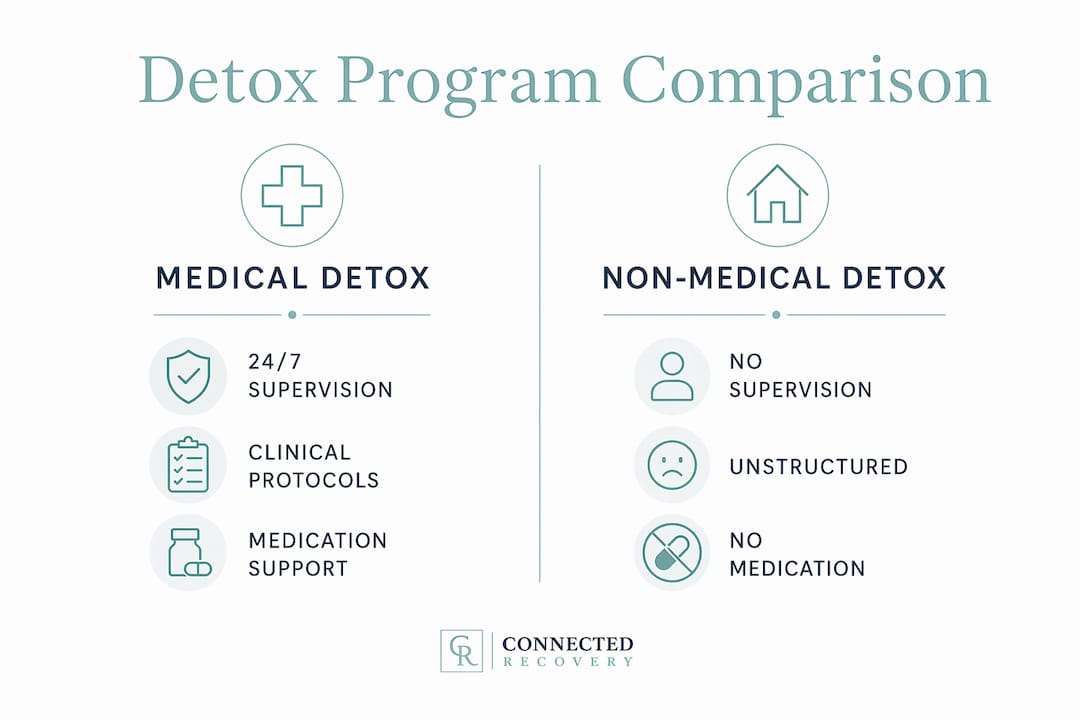
Hospital-based detox and residential detox centers both offer medical supervision, but they differ in important ways. Hospital units prioritize acute medical stabilization and often discharge patients within days, sometimes before they are ready for the next step. Specialized detox facilities provide more personalized care and integrate transition planning into the detox stay itself. That integration is what improves readiness for ongoing treatment.
Medical detox is the right level of care when:
- You are withdrawing from alcohol, benzodiazepines, or opioids
- You have a history of seizures or prior complicated withdrawals
- You have co-occurring medical or psychiatric conditions
- Previous attempts to stop without help have failed
- You need a structured environment to begin recovery
Medical detox is also covered under the Affordable Care Act and Medicaid in all states as an essential health benefit. That coverage makes access more realistic than many people assume.
What role does medical detox play in long-term addiction recovery?
Medical detox addresses physical dependence. It clears the substance from your system and stabilizes your body enough to engage in real treatment. Without that physical stability, psychological therapy cannot take hold. You cannot process trauma or build coping skills when your nervous system is in crisis.
The primary goal of medical detox is medical stabilization, not addiction treatment. This distinction is widely misunderstood, and that misunderstanding costs lives. Completing detox and leaving without a follow-up plan is one of the most common and dangerous mistakes in recovery.
Relapse rates exceed 80% within 30 days when patients do not transition into residential treatment, a partial hospitalization program (PHP), an intensive outpatient program (IOP), or ongoing medication-assisted treatment after detox. That number is not a judgment. It reflects the biology of addiction and the gap that detox alone cannot fill.
Effective transition planning includes:
- Securing a placement in residential or outpatient treatment before detox ends
- Continuing buprenorphine or methadone as part of an ongoing MAT program
- Addressing co-occurring mental health conditions through dual diagnosis treatment
- Establishing a relapse prevention plan with your clinical team
- Connecting with peer support, case management, and aftercare services
Pro Tip: Before you enter detox, ask the facility what your discharge plan looks like. If they cannot answer that question on day one, push harder. A detox program without a transition plan is incomplete care.
The facilities that produce the best long-term outcomes treat detox as chapter one, not the whole book. They build the next steps into the program from the start, not as an afterthought on the day you leave.
Key takeaways
Medical detoxification is a clinically supervised process that stabilizes physical withdrawal. Without follow-up treatment, it does not prevent relapse or address addiction.
| Point | Details |
|---|---|
| Detox is not treatment | Medical detox manages physical withdrawal; addiction treatment addresses behavior and psychology. |
| Medications are essential | Benzodiazepines, buprenorphine, and methadone prevent dangerous withdrawal complications. |
| Duration varies by substance | Most programs last 3–10 days; benzodiazepine tapers may extend to weeks. |
| Non-medical detox carries fatal risk | Unsupervised alcohol and benzodiazepine withdrawal can cause fatal seizures. |
| Transition planning is non-negotiable | Relapse rates exceed 80% within 30 days without follow-up residential or outpatient care. |
Why detox without a plan is the most dangerous step in recovery
Medical detox saves lives. I have seen it do exactly that for people who came in convinced they could manage withdrawal on their own. The clinical reality is that alcohol and benzodiazepine withdrawal can kill without warning, and no amount of willpower changes that physiology.
What concerns me more than the detox itself is what happens after. The most common failure point in recovery is not the withdrawal. It is the gap between leaving detox and starting real treatment. People feel physically better, they think the hard part is over, and they go home. Within weeks, most relapse. The research backs this up: over 80% relapse without structured follow-up care.
The facilities that get this right treat transition planning as part of the detox protocol, not an optional add-on. If a program cannot tell you on intake day where you are going next, that is a red flag. Advocate for yourself or for your loved one. Ask directly: “What is the plan after detox?” The answer tells you everything about the quality of care you are receiving.
Detox is hope made clinical. It is the moment the body gets a chance to reset. But hope without a plan is just a feeling. The goal is to turn that reset into a foundation for something lasting.
— Jim
Start your recovery at Connected Recovery
Connected Recovery operates a 12-bed medical detox program in Van Nuys, CA, built around the principle that personalized care produces better outcomes than volume-based treatment. Every patient receives 24/7 medical supervision, individualized medication protocols, and a transition plan that begins on day one. The small facility size means your care team knows your name, your history, and your goals. Connected Recovery also treats co-occurring mental health conditions alongside substance use, so nothing gets left unaddressed. If you or someone you care about is ready to take the first step, explore medical detox in Van Nuys or review the full range of addiction treatment programs available. You can also start the admissions process today.
FAQ
What is medical detoxification in simple terms?
Medical detoxification is the clinically supervised process of safely removing addictive substances from your body while managing withdrawal symptoms with medications and 24/7 monitoring. It is the first step in addiction recovery, not the complete treatment.
How long does medical detox typically last?
Most medical detox programs last 3–10 days. Benzodiazepine tapers can extend to several weeks depending on the substance and the patient’s clinical needs.
Is medical detox covered by insurance?
Medical detox is covered as an essential health benefit under the Affordable Care Act and Medicaid in all states. Most private insurance plans also cover it, making authorization typically more straightforward than for other levels of care.
What happens after medical detox ends?
After detox, patients should transition directly into residential treatment, a partial hospitalization program, an intensive outpatient program, or ongoing medication-assisted treatment. Without this step, relapse rates exceed 80% within 30 days.
What is the difference between detox and addiction treatment?
Detox manages the physical withdrawal process and stabilizes the body. Addiction treatment addresses the psychological, behavioral, and social factors that drive substance use. Both are necessary for lasting recovery.
Recommended
DHCS Licensed · Joint Commission Accredited
If you or a loved one is struggling with substance use, our admissions team is available to verify your insurance benefits and help you begin recovery. All calls are confidential.