
Why Treatment Customization Matters for Recovery

Treatment customization is the deliberate process of tailoring addiction and mental health care to the unique biological, psychological, and social needs of each patient. Generic, one-size-fits-all programs consistently underperform because they ignore the variability that defines human health. Recent clinical trials and real-world data confirm that why treatment customization matters comes down to one measurable truth: personalized plans produce better engagement, fewer dropouts, and stronger long-term recovery outcomes. Tools like the PETRUSHKA decision-support system and frameworks like SAMHSA’s TIP 42 now give clinicians the evidence base to act on that truth.
Why does treatment customization matter for recovery outcomes?
Personalized treatment plans improve outcomes because they align care with what each patient actually needs, not what a population average predicts. Personalization increases engagement by making treatment feel relevant to individual priorities, which translates directly into better long-term behavioral improvements. When patients see their specific goals reflected in their care plan, they participate more actively and stay in treatment longer.
The University of Chicago found that early tailoring in treatment sessions predicts better patient engagement and behavior change at 12 months, even when not every program element is customized. That finding reframes where clinicians should invest their effort. Getting the first session right matters more than perfecting every downstream protocol.
Medication selection is another area where personalization produces measurable gains. A randomized clinical trial of 520 adults using the PETRUSHKA decision-support tool showed a 10-percentage-point reduction in treatment discontinuation at both 8 and 24 weeks, along with lower depressive symptoms. That reduction represents real patients who stayed in care instead of dropping out.
“The initial tailoring session is the most pivotal moment in a treatment relationship. Clinicians who invest in a thorough, collaborative needs assessment at the start set the trajectory for everything that follows.”
Pro Tip: Ask your care team to document your specific goals, preferences, and concerns in writing during your first session. That document becomes the foundation for every adjustment made to your plan.
Why does patient variability make one-size-fits-all treatment fail?
No two patients arrive at treatment with the same biology, history, or circumstances. Patient heterogeneity in biological and psychosocial factors demands precision treatment to improve outcomes beyond what population averages can deliver. Two people presenting with identical depression symptoms may have entirely different underlying neurological profiles, which means the same antidepressant will work for one and fail the other.

Precision psychiatry addresses this directly. It treats the same diagnosis as a collection of distinct subtypes rather than a single condition. A patient with treatment-resistant depression caused by inflammatory pathways needs a different pharmacologic approach than one whose depression stems from a serotonin deficit. Applying the same protocol to both wastes time and increases the risk of early dropout.
The contrast between standardized and customized approaches is stark in practice:
| Approach | Medication selection | Therapy type | Dropout risk | Outcome focus |
|---|---|---|---|---|
| Standardized | Protocol-driven, same first-line drug | Fixed modality for all | Higher due to poor fit | Population average |
| Customized | Based on patient profile, tolerability, preference | Matched to patient needs and history | Lower with early tailoring | Individual remission |
Personalized medicine improves adherence by aligning treatment with patient preferences, which increases the likelihood that patients follow through with prescribed therapies. Adherence is not a character trait. It is a design outcome. When a plan fits, patients follow it.
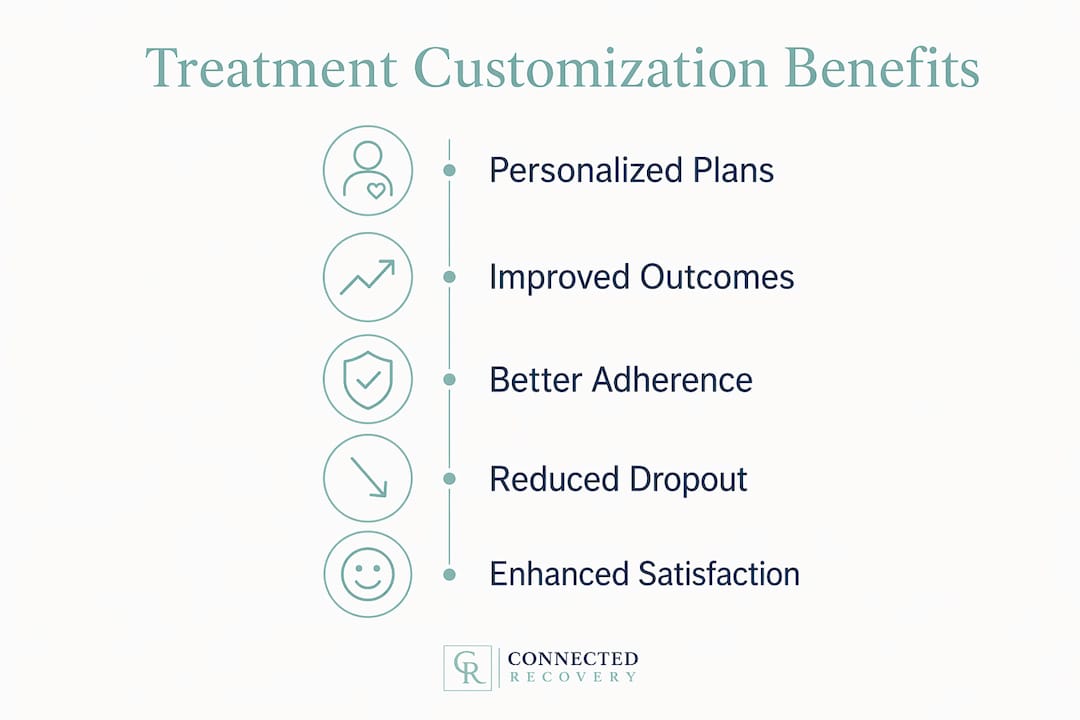
Tolerability is as important as efficacy in medication selection. A drug that works in theory but causes side effects the patient cannot tolerate will be abandoned. Customized pharmacologic strategies account for both dimensions from the start, reducing the trial-and-error cycle that frustrates patients and clinicians alike.
What does integrated customization look like for co-occurring disorders?
Co-occurring substance use and mental health disorders are the rule, not the exception, in addiction treatment populations. Integrated, person-centered care is essential for these patients to avoid fragmented treatment and support simultaneous management of both conditions. Treating one disorder while ignoring the other produces partial results at best.
SAMHSA’s TIP 42 guidelines provide the evidence-based framework for this integration. Key principles include:
- Concurrent screening and assessment for both substance use and mental health conditions at intake, not sequentially
- Coordinated management plans that address both disorders within a single care team
- Use of medication-assisted treatment (MAT) alongside structured psychotherapy, not as separate tracks
- Regular reassessment to adjust the plan as both conditions evolve
- Patient education so individuals understand why both conditions require simultaneous attention
The outcomes data for integrated approaches is compelling. Real-world data from 112 U.S. organizations showed that combining MAT with psychotherapy produces a more than fivefold increase in remission for opioid use disorder compared to untreated individuals. That is not a marginal improvement. It reflects the difference between a plan that addresses the whole person and one that addresses only part of the problem.
Advanced personalization extends even to neurological interventions. A 2026 case report in Nature Communications documented that personalized deep brain stimulation parameters, guided by behavioral and electrophysiological monitoring, produced sustained reduction in opioid cravings and abstinence at six months. The parameters were adjusted iteratively based on the patient’s own neural responses. That level of customization represents where the field is heading for the most complex cases.
Patients with dual diagnosis conditions benefit most from this integrated model because their recovery depends on both disorders being treated with equal clinical attention.
How can providers implement treatment customization effectively?
Effective customization requires a structured approach, not improvisation. Clinicians who treat personalization as an afterthought produce plans that look individualized on paper but function as standardized care in practice.
- Conduct a thorough collaborative needs assessment in session one. Ask patients to rank their priorities, not just describe their symptoms. What matters most to them shapes what the plan addresses first.
- Use decision-support tools for medication selection. The PETRUSHKA system demonstrated in a randomized clinical trial that factoring in patient-specific tolerability and preference data reduces early discontinuation. Clinicians should not rely on intuition alone when validated tools exist.
- Set collaborative goals with the patient, not for the patient. Goals imposed without patient input rarely survive contact with real life. Goals built together create shared accountability.
- Build in scheduled reassessment points. A plan that was right at week one may need adjustment at week six. Recovery is not linear, and treatment plans should not be static.
- Document what is not working as carefully as what is. Tracking failed approaches prevents repeating them and builds a clearer picture of what the individual actually responds to.
Pro Tip: If your current treatment plan has not been reviewed in more than 30 days, request a reassessment. Stagnant plans are one of the most common and preventable causes of relapse.
Common pitfalls include over-relying on intake assessments without follow-up, treating medication and therapy as separate decisions, and confusing patient preference with clinical appropriateness. The best plans integrate both. Providers who explore individualized addiction treatment models find that the investment in early customization pays off in sustained engagement and lower dropout rates.
Key Takeaways
Personalized treatment plans produce better recovery outcomes because they align care with individual biology, preferences, and circumstances rather than population averages.
| Point | Details |
|---|---|
| Early tailoring drives long-term results | Customizing the first session predicts better engagement and behavior change at 12 months. |
| Medication personalization reduces dropout | The PETRUSHKA tool cut treatment discontinuation by 10 percentage points at 8 and 24 weeks. |
| Integrated care multiplies remission rates | Combining MAT with psychotherapy produces more than fivefold higher remission in opioid use disorder. |
| Patient variability demands precision | Biological and psychosocial differences mean identical symptoms require different treatment strategies. |
| Reassessment keeps plans effective | Static plans become misaligned with patient progress; scheduled reviews prevent stagnation and relapse. |
What I’ve seen that most treatment programs still get wrong
I have spent years watching treatment programs promise personalization while delivering standardized care with a patient’s name on the cover page. The gap between what research shows and what actually happens in most clinical settings is wider than most people realize.
The University of Chicago research on early tailoring confirmed what good clinicians have always known intuitively: the first session sets everything. Yet most programs spend that session on paperwork and intake forms rather than genuine collaborative goal-setting. That is a structural failure, not a staffing one. It reflects how programs are designed, not how clinicians want to practice.
What gives me real hope is the direction of the evidence. The PETRUSHKA trial, the real-world MAT data from 112 organizations, and the deep brain stimulation case report all point toward the same conclusion. Customization is not a luxury for complex cases. It is the baseline standard that produces results. The programs that will lead recovery outcomes in the next decade are the ones building personalization into their intake process, their medication protocols, and their reassessment schedules right now.
The hardest part is not the science. The hardest part is convincing patients who have been through generic programs before that this time, the plan was actually built for them. That trust is earned through specificity, not promises.
— Jim
How Connected Recovery approaches personalized treatment
Connected Recovery operates a 12-bed facility in Van Nuys, CA, specifically designed to deliver the individualized attention that larger programs cannot. That small capacity is a deliberate clinical choice. Every patient receives a treatment plan built around their specific substance use history, mental health profile, and personal goals.
Connected Recovery’s programs include medical detox with 24/7 supervision, dual diagnosis treatment for co-occurring disorders, and medication-assisted treatment integrated with individual therapy. Each program is structured around the same evidence base described in this article: early tailoring, concurrent management of substance use and mental health, and continuous plan reassessment. If you are ready to understand what a plan built specifically for you looks like, the admissions process starts with exactly that conversation.
FAQ
What is treatment customization in addiction recovery?
Treatment customization is the process of tailoring a patient’s care plan to their specific biological, psychological, and social needs rather than applying a standard protocol. It includes personalized medication selection, matched therapy types, and collaborative goal-setting.
How does personalized treatment improve long-term outcomes?
Early tailoring of treatment sessions predicts better patient engagement and behavior change at 12 months, according to University of Chicago research. Personalization increases adherence by making care feel relevant to individual priorities.
Why does integrated care matter for co-occurring disorders?
Treating substance use and mental health disorders simultaneously, rather than sequentially, prevents fragmented care and produces substantially better outcomes. Real-world data shows that combining MAT with psychotherapy increases opioid use disorder remission rates by more than fivefold.
What is the PETRUSHKA decision-support system?
PETRUSHKA is a clinical tool that personalizes antidepressant selection by factoring in patient-specific tolerability and preference data. A randomized trial of 520 adults showed it reduced treatment discontinuation by 10 percentage points at both 8 and 24 weeks.
How often should a personalized treatment plan be reviewed?
Treatment plans should be reassessed at scheduled intervals, typically every 30 days at minimum, to reflect changes in patient progress, symptom severity, and treatment response. Static plans that are not updated increase the risk of relapse and disengagement.
Recommended
DHCS Licensed · Joint Commission Accredited
If you or a loved one is struggling with substance use, our admissions team is available to verify your insurance benefits and help you begin recovery. All calls are confidential.