How Insurance Billing Affects Rehab Privacy in 2026

Insurance billing affects rehab privacy because every claim submitted to an insurer requires sharing your protected health information with a third party. Two federal laws govern this process: HIPAA and 42 CFR Part 2, which sets stricter rules specifically for substance use disorder (SUD) records. Understanding how insurance billing affects rehab privacy is not just reassuring. It is the first step toward making informed decisions about your treatment and your confidentiality. Recent 2026 updates to 42 CFR Part 2 have changed how consent works, and those changes carry real consequences for patients in recovery.
What federal laws regulate insurance billing and rehab privacy?
HIPAA and 42 CFR Part 2 are the two primary federal frameworks that control how your treatment information moves through the billing system. They overlap in some areas but differ significantly in scope and strength.
HIPAA permits providers to share your protected health information (PHI) with insurers for treatment, payment, and healthcare operations without asking for your explicit consent each time. That means your diagnosis codes, treatment dates, and service descriptions can flow to your insurer automatically when a claim is filed. Billing processors handling that data are also covered entities under HIPAA, so billing services transmit PHI and must comply with the same privacy standards as your provider.

42 CFR Part 2 goes further. It applies specifically to SUD treatment records and requires explicit written consent for most disclosures, including those made for billing purposes. This is a meaningful distinction. Under standard HIPAA, your insurer can receive your records without you signing anything specific. Under 42 CFR Part 2, your SUD records cannot be shared without your written authorization.
The 2026 updates to 42 CFR Part 2 introduced a significant structural change. Patients can now sign a single comprehensive consent form that covers all future uses and disclosures for treatment, payment, and healthcare operations. This replaces the older model of repeated individual consents for each disclosure. The goal was to reduce administrative burden. The tradeoff is that one signature now opens the door to a broader range of downstream data sharing.
Violations of 42 CFR Part 2 now carry civil penalty enforcement by the Office for Civil Rights (OCR). That enforcement mechanism is new as of 2026 and gives these protections real teeth.
- SUD records receive stronger federal protection than general medical records.
- HIPAA allows billing disclosures without explicit consent; 42 CFR Part 2 does not.
- The 2026 single consent form simplifies paperwork but broadens data exposure.
- OCR now enforces 42 CFR Part 2 violations with civil penalties.
Pro Tip: Before signing any consent form at a treatment facility, ask your care team to walk you through exactly which entities will receive your SUD records and for what purposes. A reputable provider will answer this clearly.
How does Explanation of Benefits documentation impact rehab confidentiality?
An Explanation of Benefits (EOB) is a document your insurer sends after processing a claim. It lists the services billed, the costs, and the diagnosis codes used. EOBs are Protected Health Information under HIPAA and are typically mailed to the policyholder, not necessarily to the patient receiving treatment.
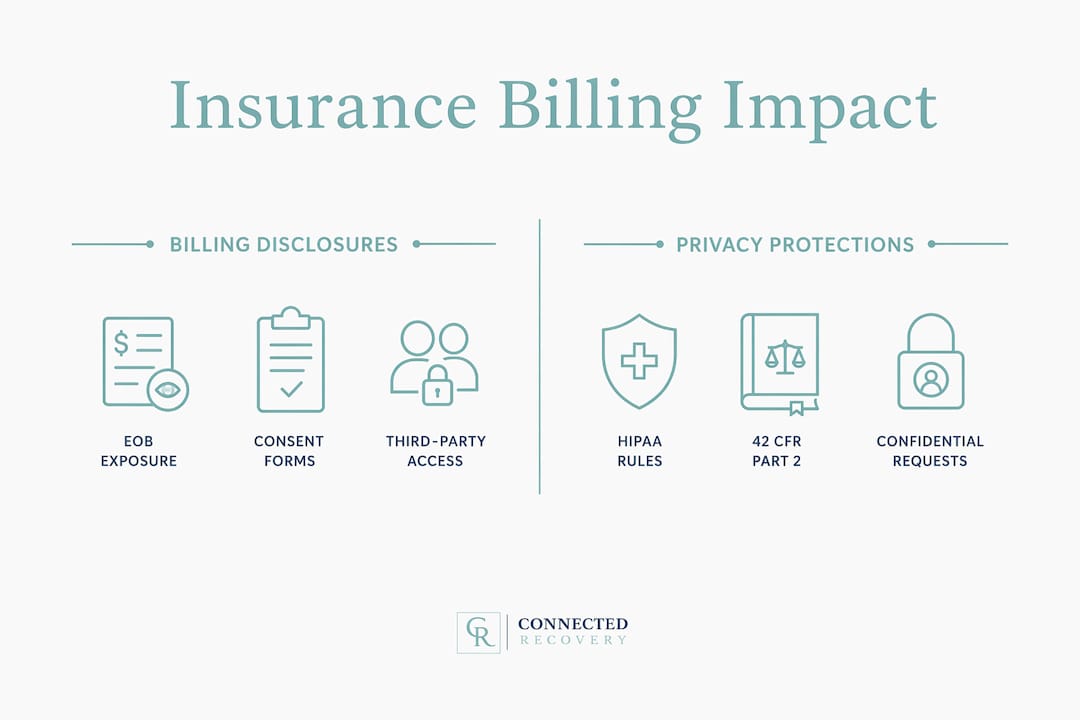
This creates a direct confidentiality risk for anyone in rehab who is covered under a family plan, a parent’s policy, or a spouse’s insurance. The policyholder receives a document that may clearly show dates of service at a substance use treatment facility, the type of treatment received, and the associated diagnosis codes. That disclosure happens automatically unless you take steps to prevent it.
EOBs sent to policyholders are a frequent source of unintended rehab privacy breaches. A young adult on a parent’s plan who enters residential treatment may have that information revealed to their family before they are ready to share it. A spouse seeking confidential outpatient care may find their treatment details on a document their partner opens in the mail.
The table below summarizes the key EOB privacy risks and the options available to address them.
| Situation | Privacy risk | Available option |
|---|---|---|
| Patient on family insurance plan | EOB mailed to parent or guardian | Request confidential communications from insurer |
| Patient on spousal insurance plan | EOB mailed to spouse | Request alternative EOB delivery to patient directly |
| Patient seeking maximum privacy | Any EOB generation reveals treatment | Pay out-of-pocket to prevent claim submission |
| Patient in a state with strong protections | EOB may still show sensitive codes | Request less descriptive service explanations |
State laws can provide greater protections than HIPAA, including the ability to suppress, delay, or redirect EOBs for sensitive service categories like SUD treatment. These state-level options vary widely, so what is available in California may not be available in another state.
Confidential communication requests are underutilized. Requesting confidential communications requires insurers to send EOBs directly to the patient rather than the policyholder. Most patients are never told this option exists.
Pro Tip: Call the member services number on your insurance card and ask specifically for “confidential communications” or “alternative communication” for your account. Get the confirmation in writing.
What are the practical risks of billing disclosures in rehab?
The real-world consequences of an unintended billing disclosure go well beyond embarrassment. Stigma around substance use disorder remains significant in employment, housing, and insurance contexts. A billing record that surfaces in the wrong place can affect your life in concrete ways.
Employment background checks do not typically access medical records directly. However, if a disclosure reaches a family member who is also an employer, or if records are improperly shared, the risk of professional consequences rises. Housing applications sometimes require disclosure of medical history, and a documented SUD treatment record could influence a landlord’s decision. Insurance eligibility and premium calculations can also be affected if SUD treatment history becomes part of an insurer’s underwriting review.
The 2026 single consent form change benefits insurance companies and downstream healthcare entities by reducing administrative burden. Experts warn this creates a situation where it becomes harder to control sensitive SUD data once it has been shared downstream. Patients who sign a broad consent without fully understanding its scope may lose meaningful control over where their information travels.
Data breaches add another layer of risk. Even when providers and billing processors follow the rules, unauthorized disclosures happen. The more entities that hold your SUD records, the larger the surface area for a potential breach. The single consent form increases the number of entities that may legitimately hold your data, which indirectly increases breach exposure.
Patients who avoid seeking treatment because of privacy fears face the most serious risk of all. Reduced privacy protections can cause some patients to delay or forgo care entirely. That outcome is far more damaging than any administrative disclosure.
How can patients protect their privacy when using insurance for rehab?
Protecting your confidentiality during rehab billing requires active steps. The system does not default to maximum privacy. You have to request it.
-
Request confidential communications. Contact your insurer directly and ask that all EOBs and billing correspondence be sent to you, not to the policyholder. This is a federally supported option under HIPAA and is available from most major insurers. Confirm the request in writing.
-
Review every consent form carefully. Under the 2026 updates to 42 CFR Part 2, a single consent form may authorize broad future disclosures. Ask your provider to identify every entity that will receive your SUD records before you sign. You have the right to understand the scope of what you are authorizing.
-
Exercise your right to pay out-of-pocket. Paying out-of-pocket gives you the legal right to restrict your provider from submitting any insurance claim. No claim means no EOB. Federal HIPAA rules require providers to honor this restriction when you pay in full. This option costs more upfront but provides the strongest privacy protection available.
-
Ask your provider about their billing practices. Not all treatment facilities handle billing the same way. Ask specifically how your information is shared with insurers, what third-party billing processors are used, and whether those processors are bound by Business Associate Agreements under HIPAA. A facility that prioritizes individualized treatment will also prioritize informed consent.
-
Know your state’s protections. Some states offer stronger privacy rules than federal law requires. California, for example, has additional protections for sensitive health information. Ask your provider or a patient advocate whether your state offers enhanced EOB controls for SUD treatment.
Pro Tip: Ask your treatment facility for a copy of their HIPAA Notice of Privacy Practices before you begin treatment. This document tells you exactly how your information is used, shared, and protected.
Key Takeaways
Insurance billing affects rehab privacy primarily through EOB disclosures and consent forms, and patients who take proactive steps retain the most control over their sensitive SUD records.
| Point | Details |
|---|---|
| Federal law governs billing disclosures | HIPAA and 42 CFR Part 2 set the rules for how SUD records are shared during billing. |
| EOBs are a primary privacy risk | EOBs go to policyholders by default, which can expose treatment details to family members. |
| Single consent forms broaden data sharing | The 2026 update allows one form to authorize all future disclosures, increasing downstream exposure. |
| Out-of-pocket payment stops EOB generation | Paying in full legally prevents providers from filing claims or generating EOBs. |
| Confidential communications are underused | Patients can request insurers send EOBs directly to them, but most never know this option exists. |
What I’ve learned about privacy and the billing system
The tension between billing requirements and patient confidentiality is real, and I think most people entering treatment underestimate how much of their information moves through the system before they ever see a bill.
What strikes me most about the 2026 consent form changes is how they shift the burden onto patients. The paperwork gets simpler for providers and insurers. The privacy risk gets larger for the person in treatment. That is a tradeoff worth naming clearly, because most intake processes do not name it at all.
The patients I have seen navigate this best are the ones who ask questions before they sign anything. They ask who receives their records. They ask whether confidential communications are available. They ask what happens to their data if they leave treatment early. Those questions feel uncomfortable in a moment when you are already vulnerable. They are also the most important questions you can ask.
Paying out-of-pocket is not realistic for everyone. But for patients with significant privacy concerns, including those in public-facing careers or in situations where a family member’s knowledge of their treatment could cause harm, it is worth a serious conversation with the billing team before treatment begins. The right facility will have that conversation with you honestly.
Privacy in recovery is not a luxury concern. It is a clinical one. Patients who feel safe are more likely to engage fully in treatment. Facilities that treat confidentiality as a core value, not an administrative checkbox, produce better outcomes.
— Jim
Privacy-conscious treatment at Connected Recovery
Connected Recovery operates as a 12-bed boutique facility in Van Nuys, CA, where individualized care means your billing and consent questions get real answers, not form letters. The team works with patients on medical detox, residential treatment, and dual diagnosis programs, all with 24/7 medical supervision and treatment plans built around your specific situation. If privacy concerns are shaping your decisions about treatment, Connected Recovery’s billing team can walk you through your options before you commit. Reach out to discuss confidential payment arrangements, consent form details, and how your information is protected throughout care.
FAQ
What is 42 CFR Part 2 and how does it protect rehab patients?
42 CFR Part 2 is a federal regulation that requires explicit written consent before SUD treatment records can be shared, including for billing purposes. It provides stronger protection than standard HIPAA rules for substance use disorder records.
Can my insurer send my EOB to someone other than me?
Yes. EOBs are typically sent to the policyholder, which may be a parent or spouse rather than the patient. You can request confidential communications to have EOBs sent directly to you instead.
Does paying out-of-pocket protect my rehab privacy?
Paying out-of-pocket gives you the legal right under HIPAA to restrict your provider from submitting any insurance claim, which prevents EOB generation entirely. Providers are required by federal law to honor this restriction.
What changed about consent forms for SUD treatment in 2026?
The 2026 updates to 42 CFR Part 2 allow a single consent form to cover all future disclosures for treatment, payment, and healthcare operations. This simplifies paperwork but increases the risk of broader downstream data sharing.
Are third-party billing companies required to protect my treatment information?
Yes. Billing processors that handle PHI on behalf of providers are covered under HIPAA as Business Associates and must comply with the same privacy standards as the treating facility itself.
Recommended
DHCS Licensed · Joint Commission Accredited
If you or a loved one is struggling with substance use, our admissions team is available to verify your insurance benefits and help you begin recovery. All calls are confidential.