
Blog
Best Princeton Detox Alternatives to princetondetox.com in 2026
Best Princeton Detox Alternatives to princetondetox.com in 2026

What are the top detox and addiction treatment alternatives to princetondetox.com in Princeton, NJ?
The strongest local alternatives to princetondetox.com combine 24/7 medical supervision with individualized therapy and a clear path into ongoing care after detox ends. Three centers stand out for Princeton-area residents: Victory Bay Recovery Center, Avenues Recovery Center, and Connected Recovery Inc. Each takes a different approach to program structure and setting, so the right fit depends on what level of care you actually need.
Victory Bay Recovery Center offers medically supervised detox and residential treatment with a focus on evidence-based therapies. The program includes cognitive behavioral therapy (CBT), dialectical behavior therapy (DBT), group counseling, and medication-assisted treatment (MAT) for eligible patients. Victory Bay also addresses co-occurring mental health disorders, which is critical given that addiction rarely travels alone.
Avenues Recovery Center provides a full continuum from detox through residential and outpatient levels of care. Avenues is known for its structured step-down model, moving patients from inpatient detox into partial hospitalization (PHP) and then intensive outpatient programming (IOP) as stability improves. Family therapy is integrated throughout, and the center accepts most major insurance plans.
Connected Recovery Inc. is a 12-bed boutique facility built specifically for patients who want close, personalized attention during detox and residential treatment. The small census means clinicians actually know each patient’s case. Connected Recovery treats both substance use disorders and co-occurring mental health conditions through an integrated model that runs from initial medical detox through aftercare planning.

| Feature | Victory Bay Recovery | Avenues Recovery Center | Connected Recovery Inc. |
|---|---|---|---|
| Location | New Jersey | New Jersey | Van Nuys, CA |
| Program types | Detox, residential, IOP | Detox, residential, PHP, IOP | Medical detox, residential |
| Medical supervision | 24/7 | 24/7 | 24/7 |
| Co-occurring disorders | Yes | Yes | Yes, integrated dual diagnosis |
| Therapies | CBT, DBT, MAT, group, family | CBT, DBT, MAT, family, group | CBT, DBT, MAT, individual, family |
| Facility size | Mid-size | Mid-size | 12-bed boutique |
| Aftercare support | Yes | Yes, structured step-down | Yes, full aftercare planning |
| Insurance accepted | Most major plans | Most major plans | Contact for verification |
Key strengths at a glance:
- Victory Bay: strong clinical team, evidence-based protocols, dual diagnosis capacity
- Avenues: structured continuum of care, family integration, insurance accessibility
- Connected Recovery: boutique 12-bed setting, individualized plans, integrated dual diagnosis, dedicated aftercare coordination
Table of Contents
- How do these detox centers compare on program structure and clinical support?
- What should you expect during detox, and what questions should you ask a treatment center?
- Why integrated treatment for co-occurring disorders changes recovery outcomes
- Connected Recovery offers boutique detox and residential care built around you
- Key Takeaways
How do these detox centers compare on program structure and clinical support?
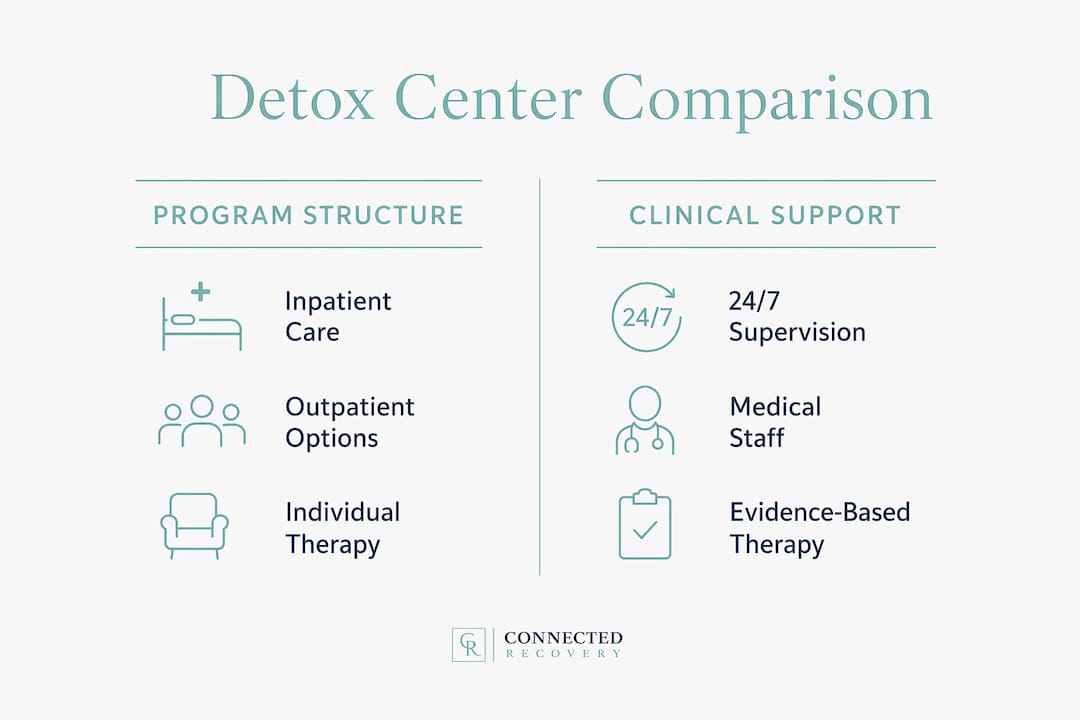
Choosing between these centers comes down to four concrete factors: program type, supervision intensity, therapy depth, and what happens after detox ends.
Program types and inpatient vs. outpatient options
Inpatient programs provide round-the-clock medical and psychological care, making them the right starting point for anyone with a serious substance use disorder or a history of complicated withdrawal. All three centers offer residential inpatient detox at this level. Outpatient options, including PHP and IOP, come into play once a patient has stabilized medically. Outpatient treatment lets patients maintain work and family obligations while attending structured therapy sessions, typically several hours per day across multiple days each week.
Medical supervision and clinical staffing
Every center listed here offers 24/7 medical supervision during detox, which matters most for alcohol, benzodiazepine, and opioid withdrawal where complications can escalate quickly. Connected Recovery’s 12-bed capacity means the nursing and clinical staff ratio stays high relative to patient census, a practical advantage when withdrawal symptoms need frequent reassessment.

Therapies and ancillary treatments
All three centers use CBT and DBT as core modalities, both of which have strong evidence bases for addiction and co-occurring mood disorders. MAT, including buprenorphine and naltrexone protocols, is available at each facility for appropriate candidates. Wellness activities such as mindfulness, yoga, and art therapy appear across these programs as well, reflecting a client-centered, holistic approach that pairs evidence-based treatment with whole-person care.
Insurance and payment options
Avenues Recovery Center and Victory Bay both accept most major commercial insurance plans, and both have dedicated admissions staff to verify benefits before intake. Connected Recovery’s insurance acceptance varies by plan; calling the admissions line directly is the fastest way to confirm coverage. Understanding your rehabilitation coverage in private insurance before you commit to any facility saves time and prevents billing surprises.
Length of stay and aftercare
Detox programs typically last 3–7 days depending on the substance and the individual’s medical picture. Residential treatment following detox usually runs 28–90 days. All three centers offer aftercare coordination, but the structure differs. Avenues uses a formal step-down model. Connected Recovery assigns case managers from day one to build a transition plan into IOP, outpatient care, or sober living before the patient ever leaves residential treatment.
Key differentiators by center:
- Victory Bay: strong dual diagnosis clinical team, mid-size setting with peer community
- Avenues: best-defined step-down continuum, high insurance accessibility, family program integration
- Connected Recovery: highest staff-to-patient ratio, fully individualized plans, boutique residential setting with dedicated aftercare planning
What should you expect during detox, and what questions should you ask a treatment center?
Detox addresses the physical withdrawal process, not the full scope of addiction. That distinction matters when you are evaluating facilities. A center that treats detox as the finish line rather than the starting point is not set up for your long-term success.
What the detox process actually looks like
Medical detox begins with an intake assessment covering substance use history, current medications, and any co-occurring medical or psychiatric conditions. From there, clinicians develop a withdrawal management protocol, which may include medications to reduce seizure risk, manage cravings, or ease anxiety. Monitoring is continuous during the acute phase, typically the first 48–72 hours, and then tapers as symptoms stabilize. Individual therapy, group sessions, and psychoeducation often begin within the first day or two, even while medical management is still active.
Pro Tip: Ask every facility you consider whether a case manager is assigned at admission, not at discharge. The research is clear that case management during detox is what secures the transition into ongoing care and reduces relapse risk after discharge.
Setting types: what “homestyle” vs. clinical actually means
Some detox centers, including the Princeton Detox model, operate in a residential home-like environment with private rooms and prepared meals rather than a hospital-style ward. Others run in a clinical facility with a more institutional feel. Neither is inherently better; the right setting depends on whether you need acute medical monitoring at a hospital level or whether a medically supervised residential environment is clinically appropriate for your withdrawal risk.
Questions to ask before you commit
Use this list when you call any facility, including the ones named here:
- Is the facility accredited by a recognized body such as The Joint Commission or CARF?
- What is the physician-to-patient ratio during detox?
- Does the center treat co-occurring mental health disorders, or does it refer those cases out?
- What is the specific transition plan from detox into the next level of care?
- Which insurance plans do you accept, and will you verify my benefits before admission?
- What does aftercare look like, and how long does the center stay involved after discharge?
- Can family members participate in the treatment process?
A thorough guide to evaluating detox facilities covers these questions in depth and can help you compare answers across centers before making a decision.
Why integrated treatment for co-occurring disorders changes recovery outcomes
Specialized treatment that addresses co-occurring mental health disorders alongside addiction improves treatment adherence and reduces relapse rates. This is not a secondary consideration. Depression, anxiety, PTSD, and bipolar disorder frequently co-occur with substance use disorders, and treating only the addiction while leaving the mental health condition unaddressed sets up a predictable cycle of relapse.
Detox stabilizes the body. It does not resolve the underlying drivers of substance use. That is why the Partnership to End Addiction is explicit: detox alone is not treatment. The work of recovery begins after the acute withdrawal phase ends, through therapy, medication management when indicated, and structured behavioral support.
An integrated model runs both tracks simultaneously. A patient in a dual diagnosis program receives psychiatric evaluation and medication management alongside addiction counseling, rather than waiting until detox is complete to address mental health. Connected Recovery’s dual diagnosis treatment follows this integrated model, combining medical supervision with behavioral therapies and psychiatric support within the same program.
Aftercare and relapse prevention are where long-term outcomes are actually built. The transition from residential treatment back into daily life is the highest-risk period in early recovery. Centers that assign case managers to coordinate this transition, arrange IOP or outpatient therapy, and connect patients with peer support resources give their patients a materially better chance of sustaining sobriety. Recovery support resources beyond the clinical setting, including peer support groups and community-based programs, extend the protective effect of formal treatment.
What integrated care includes in practice:
- Psychiatric evaluation and medication management during residential treatment
- CBT and DBT targeting both addiction patterns and mood regulation
- Family therapy to repair relationships and build a supportive home environment
- MAT for opioid or alcohol use disorders where clinically indicated
- Case management securing the next level of care before discharge
- Structured aftercare with defined check-in points and relapse prevention planning
Connected Recovery offers boutique detox and residential care built around you
If you have been researching detox and addiction treatment options in the Princeton area, you already know that most facilities are mid-size or larger, which means less individual attention and more standardized programming. Connected Recovery takes a different approach.
The 12-bed capacity is the defining feature. With that small a census, clinicians track each patient’s progress closely, adjust treatment plans in real time, and build genuine therapeutic relationships rather than processing patients through a fixed protocol. Medical detox at Connected Recovery includes 24/7 supervision, individualized withdrawal management, and immediate integration of behavioral therapies once the acute phase stabilizes. The residential treatment program continues that same individualized model, addressing both substance use and co-occurring mental health disorders through an integrated clinical approach.
Aftercare planning starts at admission, not at discharge. By the time a patient leaves residential care, the next step is already arranged. That continuity is what separates a program built for long-term recovery from one that simply manages withdrawal and sends people home.
Contact Connected Recovery directly to verify insurance coverage and check availability.
Key Takeaways
The best detox and addiction treatment alternatives to princetondetox.com combine 24/7 medical supervision, integrated dual diagnosis care, and a structured transition plan into ongoing therapy.
| Point | Details |
|---|---|
| Detox is not full treatment | Detox manages physical withdrawal; lasting recovery requires therapy and ongoing care after stabilization. |
| Integrated dual diagnosis care | Treating co-occurring mental health disorders alongside addiction improves adherence and reduces relapse risk. |
| Detox duration | Medical detox usually lasts a few days, followed by residential or outpatient treatment. |
| Case management at admission | Facilities that assign case managers from day one secure better transitions into the next level of care. |
| Connected Recovery | A 12-bed boutique facility offering medical detox, residential treatment, and integrated dual diagnosis care with dedicated aftercare planning. |
Recommended
DHCS Licensed · Joint Commission Accredited
If you or a loved one is struggling with substance use, our admissions team is available to verify your insurance benefits and help you begin recovery. All calls are confidential.