
Blog
Benzo Detox Timeline for People Tapering: 2–6 Weeks, Emergency Signs
Benzo Detox Timeline for People Tapering: 2–6 Weeks, Emergency Signs

Benzo withdrawal usually starts within 6 to 12 hours for short-acting drugs like Xanax, or 1 to 4 days for long-acting ones like Valium. Acute symptoms peak in the first week and most improve significantly within 2 to 6 weeks. About 10% to 15% of long-term users go on to experience protracted withdrawal that can stretch on for months, which is why timeline expectations matter as much as the taper itself.
TL;DR:
- Acute withdrawal symptoms typically peak within the first week, with seizure risk highest during days 1 to 10 depending on the drug’s half-life.
- Longer use, higher doses, and rapid tapering significantly increase the likelihood of prolonged protracted withdrawal symptoms lasting months.
- Physical and psychological symptoms, such as tremors, anxiety, and brain fog, can persist well into the protracted phase and may require medical support.
- Emergency symptoms like seizures, chest pain, or severe confusion demand immediate medical attention to prevent life-threatening complications.
- A medically supervised taper over months, using gradual dose reductions, lowers seizure risk and ensures safer, more manageable detoxification.
Table of Contents
- How Long Does Benzo Withdrawal Last? The Phase-by-Phase Timeline
- Benzo Withdrawal Symptoms: What Shows Up and When
- What Makes Benzo Withdrawal Worse or Longer
- Emergency Warning Signs During Benzo Withdrawal
- Medically Supervised Tapering: How Detox Actually Reduces Risk
- What Specialists Say About Long Tapers and Realistic Timelines
- Inside a Boutique Medical Detox: How Tapering Actually Gets Managed
- Get Medically Supervised Benzo Detox at Connected Recovery
- Where to Verify This Information and Get Help Now
- Sources
How Long Does Benzo Withdrawal Last? The Phase-by-Phase Timeline
The benzo detox timeline moves in stages, and where you land on it depends heavily on which drug you took and for how long. Onset timing splits sharply by half-life. Short-acting benzodiazepines such as alprazolam typically trigger withdrawal within 6 to 12 hours of the last dose, sometimes faster in people on high doses. Long-acting agents like diazepam or clonazepam can take 24 to 72 hours, occasionally longer, before symptoms show up, because the drug and its active metabolites are still clearing the bloodstream.
Acute withdrawal is the roughest stretch. For short-acting benzodiazepines, the most intense days tend to fall between day 1 and day 4, with the overall acute phase running through roughly day 7 to day 10. Long-acting drugs spread that intensity out over a longer, flatter curve, sometimes not peaking until the second week. Either way, this is the period with the highest seizure risk and the reason medical supervision matters most right here.
Subacute recovery covers weeks 2 through 6. Symptoms generally decline during this window, though not in a straight line. Sleep often normalizes last, and anxiety can spike again around the third or fourth week even as physical symptoms fade.
Protracted withdrawal, sometimes called PAWS, affects an estimated 10% to 15% of long-term users. It doesn’t behave like acute withdrawal. Instead, it follows a “windows and waves” pattern, good stretches followed by unpredictable flare ups, and it can persist for months. A few factors shift these ranges in either direction:
- Higher doses and longer duration of use both raise acute severity and protracted risk.
- Fast tapers or abrupt stops intensify and often prolong every phase.
- Co-use of alcohol or opioids complicates the timeline and adds danger.
- Cross-tapering to a longer-acting benzodiazepine tends to smooth the curve out.
Benzo Withdrawal Symptoms: What Shows Up and When
Withdrawal symptoms cluster into predictable categories, and knowing which ones are common versus which ones signal an emergency changes how you respond to them. Psychological symptoms usually arrive first and hit hardest: anxiety, panic attacks, insomnia, and irritability often show up within the first day or two and can persist through the acute phase and into the subacute weeks.

Physical symptoms tend to run alongside the psychological ones. Expect tremor, sweating, nausea or other GI upset, heart palpitations, muscle aches, and headaches, most concentrated in the first one to two weeks.
Statistic: Clinical estimates put the odds of acute withdrawal at 50% to 80% for anyone who used benzodiazepines for more than six months, a range that reflects how much dose and duration drive the outcome.
Serious neurological events deserve separate attention. Seizures and, less commonly, withdrawal-induced psychosis occur most often in the first week, particularly after abrupt cessation from high doses. These are medical emergencies, not symptoms to ride out at home.
Protracted withdrawal brings its own signature complaints, often sensory and cognitive rather than purely physical:
- Persistent tinnitus or unusual skin sensations
- Brain fog, memory lapses, or trouble concentrating
- Depersonalization or a sense of unreality
- Waves of anxiety that return without an obvious trigger
Clinical literature on benzodiazepine withdrawal notes that these sensory and cognitive symptoms can linger for months after blood levels of the drug are undetectable, because neuroadaptation in the brain resolves on a much slower schedule than pharmacokinetic clearance.
What Makes Benzo Withdrawal Worse or Longer
Not everyone’s timeline looks the same, and a handful of factors reliably predict a rougher road. Dose and duration matter most: someone on a high dose of clonazepam for three years faces a different risk profile than someone who took a low dose of Ativan for two weeks.
- Higher daily dose and longer total duration of use raise both acute severity and the odds of protracted withdrawal.
- Short-acting agents combined with rapid or unsupervised tapering sharply increase seizure risk.
- Polysubstance use, especially alcohol or opioids, and any history of prior withdrawal seizures raise danger substantially.
- Preexisting anxiety, depression, or unmanaged medical conditions can slow recovery and blur the line between withdrawal and relapse of the original disorder.
That last point trips people up constantly. A returning anxiety disorder can look identical to protracted withdrawal, and telling them apart usually requires a clinician who knows the patient’s history, not a quick self-assessment.
Emergency Warning Signs During Benzo Withdrawal
Certain symptoms mean stop what you’re doing and get emergency care immediately, not “wait and see.”
- Any seizure, even a brief one, or a sudden loss of consciousness.
- Chest pain, severe shortness of breath, or a racing heart that won’t settle.
- Confusion, disorientation, or hallucinations paired with agitation.
- Uncontrolled vomiting, especially with signs of dehydration.
- Suicidal thoughts or a sudden, severe drop in mood.
Emergency clinicians assess seizure risk largely from dose history, taper speed, and vital sign instability, then monitor blood pressure, heart rate, and temperature closely. Typical interventions include administering a benzodiazepine to stabilize the nervous system, IV fluids, continuous monitoring, and, in severe cases, admission to an ICU for close observation.
Medically Supervised Tapering: How Detox Actually Reduces Risk
Abrupt cessation is where most of the serious danger in benzo withdrawal comes from, and it’s almost entirely avoidable. A supervised taper controls the rate of decline in blood benzodiazepine levels, which directly lowers seizure risk and keeps the nervous system from being shocked into a crisis state.
Most protocols favor gradual, individualized reductions over speed. The Ashton Manual recommends cuts in the range of 5% to 10% of the current dose every one to two weeks, adjusted based on how the person is responding, rather than a fixed schedule. For patients on short-acting drugs or complicated regimens, clinicians often cross-taper to a longer-acting benzodiazepine like diazepam first, since it produces steadier blood levels and a gentler symptom curve.
Adjunct medications play a supporting, not primary, role:
- Non-addictive agents for sleep disruption during the taper.
- Blood pressure medications to blunt autonomic symptoms like racing heart or sweating.
- Anti-nausea medication for GI symptoms when needed.
Nonpharmacologic support matters just as much, particularly for protracted symptoms. Cognitive behavioral therapy, structured sleep hygiene, and a solid aftercare plan all reduce the odds that lingering anxiety or insomnia gets misread as a reason to reinstate the benzodiazepine.
Pro Tip: If your taper schedule feels too fast, say so. Ashton Manual protocols are built to flex around how you’re actually responding, not a printed calendar.
What Specialists Say About Long Tapers and Realistic Timelines
The AAAP’s 2025 clinical guidance puts acute withdrawal incidence at 50% to 80% for long-term users, with 10% to 15% developing protracted symptoms, and recommends planning tapers in months, not weeks, for anyone on benzodiazepines long-term.
Protracted withdrawal tends to follow a “windows and waves” pattern rather than a steady climb toward recovery. Specialists increasingly recommend setting taper timelines in months from the start, since rushing a taper to hit an arbitrary deadline is one of the more common reasons people relapse into use or land back in acute withdrawal.
Shared decision-making works best here: agree on a starting pace, build in room to pause if symptoms spike, and revisit the plan regularly instead of locking in a fixed end date.
Inside a Boutique Medical Detox: How Tapering Actually Gets Managed
A well-run residential detox starts with a thorough intake, current medications, dosing history, co-occurring conditions, then moves the patient onto continuous monitoring so vital signs and withdrawal symptoms get tracked around the clock, not just at scheduled check-ins. From there, the taper itself gets built around that individual, adjusted week to week based on how symptoms are actually presenting, not a printed schedule everyone follows the same way. A mental health evaluation typically runs in parallel, since anxiety or mood disorders often surface or intensify during a benzo taper. Aftercare planning starts well before discharge, because the safety-first goal of medical detox is a stable handoff into ongoing care, not just getting through the acute week.
Get Medically Supervised Benzo Detox at Connected Recovery
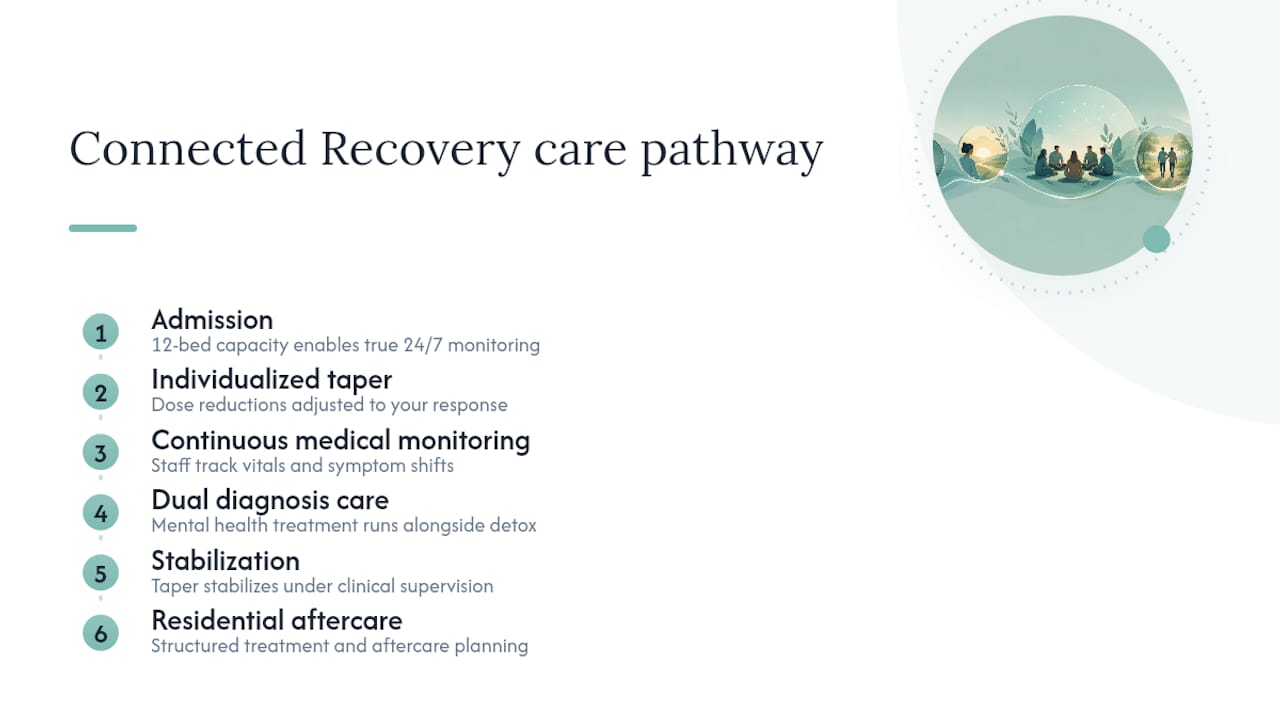
Connected Recovery gives benzo detox patients something larger facilities often can’t: a 12-bed capacity that means round-the-clock monitoring is actually round-the-clock, not shared across dozens of patients on the same floor.

Detox here is built around the individualized pacing this article just walked through, dose reductions adjusted to how you’re actually responding, not a fixed calendar, with 24/7 medical staff tracking vitals and symptom shifts throughout. For patients dealing with co-occurring anxiety, depression, or other mental health conditions alongside benzodiazepine dependence, dual diagnosis care runs alongside detox rather than waiting until after. Once the taper stabilizes, residential treatment and structured aftercare planning carry that stability forward instead of leaving it to chance.
If you’re weighing whether to taper at home or under supervision, start by reviewing what medical detox at Connected Recovery actually involves, then reach out to talk through your specific dose, duration, and history. That conversation, not a generic taper chart, is what determines your real timeline.
Where to Verify This Information and Get Help Now
The clinical claims above draw on the American Academy of Addiction Psychiatry’s guidance on tapering benzodiazepines, the Ashton Manual’s withdrawal protocols, and SAMHSA’s treatment resources. For general recovery-support reading on avoiding common detox missteps, this partner overview of detox mistakes covers useful ground beyond the medical basics.
If you or someone you’re with is in crisis, in the middle of withdrawal or otherwise, contact the 988 Suicide & Crisis Lifeline by calling or texting 988, or reach the Crisis Text Line by texting HOME to 741741. Both are free, confidential, and available around the clock.
This article is general information, not a substitute for advice from a qualified doctor. Consult a qualified healthcare professional about your own circumstances before acting on anything here.
Sources
- When Tapering Benzodiazepines, Plan for the Long Game | Psychiatric News (AAAP)
- How long does Xanax last in your system? Withdrawal and more | Medical News Today
- PubMed article on benzodiazepine withdrawal symptoms
Recommended
DHCS Licensed · Joint Commission Accredited
If you or a loved one is struggling with substance use, our admissions team is available to verify your insurance benefits and help you begin recovery. All calls are confidential.