
Individualized Recovery Goal Setting: A Practical Guide

Write one sentence: “I will [specific action] by [date] because [personal reason tied to your values].” That single line, refined with SMART criteria, is the starting point of individualized recovery goal setting, and you can draft your first one in the next ten minutes.
Here’s the fast path to a working goal today:
- Pick a life-oriented target, not a symptom to erase. “Rebuild trust with my daughter” beats “stop using.”
- Convert it to an “I” statement. Ownership language changes how the goal is held in your mind. “I will call my sponsor daily for 30 days” works differently than “attend support meetings as recommended.”
- Add SMART specifics, a frequency, a date, and a reason that connects to something you actually care about.
This approach draws on the SMART criteria used in rehabilitation goal writing, the eight recovery dimensions SAMHSA outlines for whole-person planning, and Goal Attainment Scaling (GAS), a scoring method clinicians use to track whether a goal is met, exceeded, or missed. A facility like Connected Recovery builds all three into its intake process, but you don’t need a clinical team to write your first draft. You need ten minutes and honesty about what you actually want your life to look like.
Key Takeaways
Individualized recovery goals work when they’re written as personal “I” statements, structured with SMART criteria, and reviewed weekly with a clinician rather than set once and forgotten.
| Point | Details |
|---|---|
| Write one SMART goal now | Use the four-part builder: activity, supports, measurable target, and time period. |
| Limit yourself to 1 to 2 goals | More than that typically overwhelms follow-through rather than accelerating progress. |
| Build 30/60/90-day steps | Stabilize first, add harder steps at 60 days, and evaluate honestly at 90. |
| Schedule weekly reviews | Use them to catch rising cravings or worsening symptoms before they escalate. |
| Get medically supervised support | Connected Recovery integrates goal setting, weekly reviews, and dual diagnosis care within its 12-bed Van Nuys program. |
Table of Contents
- Why Individualized Recovery Goal Setting Improves Outcomes
- Core Principles for Writing Recovery Goals That Actually Fit
- How Do You Turn a Life Goal Into a SMART Recovery Goal?
- Turning the Goal Into a 30/60/90-Day Action Plan
- What Role Do Clinicians Play in Goal Setting?
- Common Mistakes That Undermine Recovery Goals
- Copy-Ready Goal Templates You Can Use Today
- Why Goals Have to Come From You, Not a Checklist
- Get Individualized Goal Planning Backed by Medical Supervision
- Frequently Asked Questions
- Sources
Why Individualized Recovery Goal Setting Improves Outcomes
Generic goals get generic results. A goal copied from a treatment binder, something like “attend 90 meetings in 90 days,” might be true and useful, but it belongs to the program, not to the person doing the work. Person-centered recovery planning exists because ownership predicts follow-through, and follow-through is what separates a plan from a wish.
The timing matters as much as the content. A scoping review of patient-centered goal-setting practices found that individualized goals improve rehabilitation outcomes, but implementation is inconsistent across programs. The review’s recommendation is specific: start goal-setting early, review it regularly, and coordinate the process across everyone involved in care rather than treating it as a one-time intake form.
The gap in practice: Programs that talk about personalization and programs that actually build it into daily clinical routine are not the same thing. The research points to a real distance between the two, which is exactly why regular review, not a single intake conversation, is what closes it.
Recovery goals should also stretch beyond substance use. SAMHSA’s recovery framework spans health, home, purpose, and community, which means a full plan touches physical health, housing stability, employment or education, and relationships, not just days sober. A goal that only tracks abstinence misses most of what recovery actually requires.
Core Principles for Writing Recovery Goals That Actually Fit
Every goal you write should pass a few basic tests before it goes on paper. These come from established person-centered recovery planning guidance, which frames goals as a “big trip destination” rather than a checklist item.
- Ownership. The goal should sound like you wrote it, not like a provider assigned it.
- Positive framing. State what you’re moving toward, not just what you’re avoiding. “I will build a daily routine that includes exercise” lands differently than “I will stop being lazy.”
- Values connection. Tie the goal to something that matters to you personally, family, faith, career, self-respect, whatever is real for you.
- Approach orientation where possible. Goals aimed at gaining something (a relationship, a skill, a role) tend to sustain motivation better than goals aimed only at avoiding something.
- Real-world measurability. If you can’t tell whether you hit it, it isn’t a goal yet. It’s a hope.
Pro Tip: Ask yourself, “How will my life actually be different if I achieve this?” If the honest answer is “I guess I’d feel less guilty,” dig deeper. The strongest goals describe a different day, not just a quieter conscience.
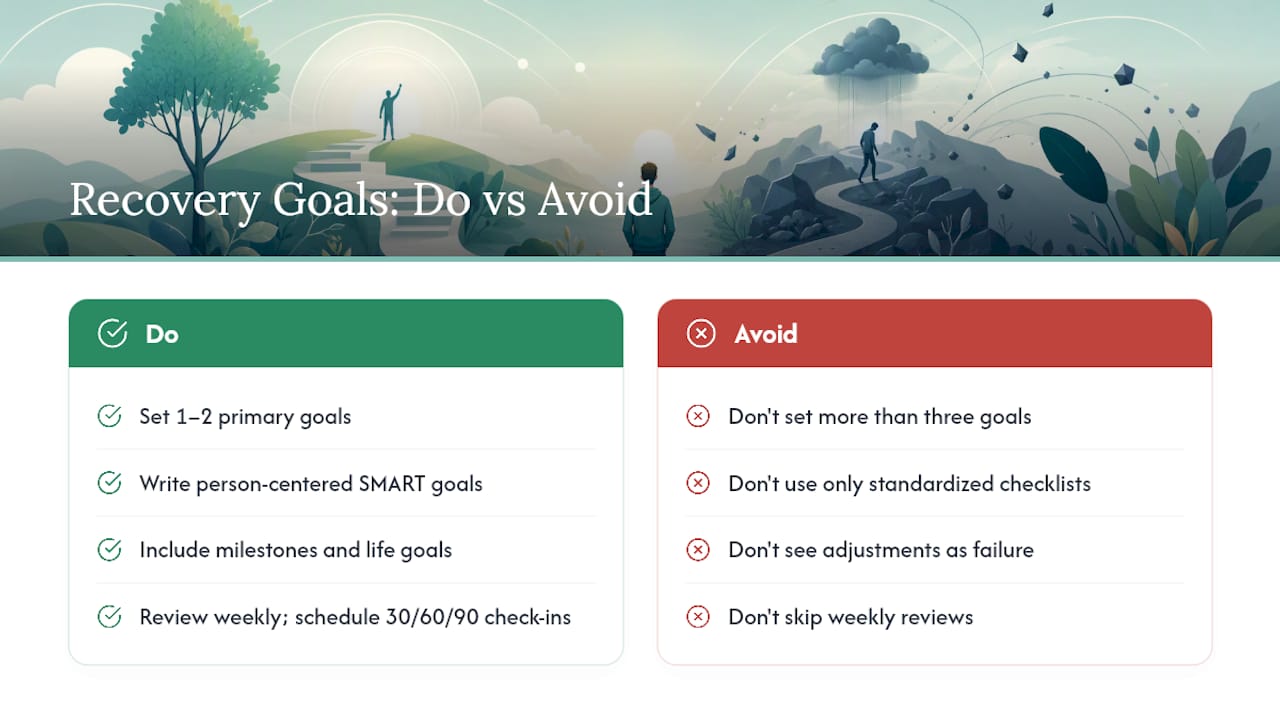
Keep the list short. PCRP guidance suggests one or two primary life goals at a time, maybe three if they’re closely related. Trying to manage too many goals at once can overwhelm focus, making it harder to progress.
How Do You Turn a Life Goal Into a SMART Recovery Goal?
A practical method used in rehabilitation settings breaks each goal into four parts, and it works just as well for addiction recovery as it does for physical rehab: the target activity, the supports or resources needed, a measurable performance target, and a time period. This four-part goal builder is what makes a goal scoreable later using Goal Attainment Scaling.
Here’s how the SMART criteria fold into that structure:
- Specific — Name the exact activity. “Improve my career” isn’t specific. “Apply to two warehouse jobs” is.
- Measurable — Attach a number or a clear yes/no marker.
- Attainable — Set a bar you can actually clear given your current supports, not the bar you wish you could clear.
- Relevant — Confirm it connects to the life vision you named earlier.
- Time-bound — Give it a deadline, even a rough one.
Three before-and-after examples:
- Recovery milestone. Before: “Stay sober.” After: “I will complete a consecutive period of sober days, tracked in a daily journal, with regular check-ins with my counselor by a target date.”
- Relationship repair. Before: “Fix things with my brother.” After: “I will call my brother once a week for one month and have one honest conversation about the past, with support from my therapist if it gets hard.”
- Vocation or education. Before: “Get my life together.” After: “I will complete my GED practice test and enroll in one class at the community college within 90 days, with help from my case manager to navigate financial aid.”
Quick checklist before you finalize any goal: Does it name a specific activity? Can someone else read it and know if you succeeded? Is the timeline realistic given your current stability? Does it connect to something you actually value?
Turning the Goal Into a 30/60/90-Day Action Plan
A goal without steps is a direction with no map. Goal Attainment Scaling gives you a simple way to score progress instead of treating outcomes as pass or fail. A basic GAS row looks like this:
| Scale Level | Description |
|---|---|
| -2 (much less than expected) | No contact attempted with estranged family member |
| -1 (less than expected) | One attempted contact, no response |
| 0 (expected level, baseline) | One phone call completed |
| +1 (more than expected) | Weekly calls established for two weeks |
| +2 (much more than expected) | In-person visit scheduled and completed |
You set the “0” as your realistic baseline expectation, then track whether you land above or below it. This turns vague hope into a number you can actually discuss with a counselor.
Build the surrounding plan in layers:
- 30 days: Stabilize the routine. Identify one support person, one daily habit, one check-in schedule.
- 60 days: Add the harder step, the phone call, the job application, the first meeting attended solo.
- 90 days: Evaluate the outcome and set the next goal based on what actually happened, not what you hoped would happen.
- Weekly review: Ask three questions. Did I take the planned action? What got in the way? Does the timeline still make sense, or does it need adjusting?
If you’re building this inside a structured program, resources like aftercare planning support can help translate the 90-day mark into a longer-term reintegration plan.
What Role Do Clinicians Play in Goal Setting?
Goal setting works best as a conversation, not a form. The strongest version involves you, a clinician, and, when it fits, family members who understand your history and daily life. In the first days of treatment, that conversation often centers on stabilization rather than ambition. Craving management, sleep, and physical safety come before career plans, and that sequencing matters.

Clinicians trained in motivational interviewing typically watch for readiness signals before pushing toward bigger, approach-oriented goals. Early sobriety often calls for avoidance-focused goals, staying away from triggers, managing withdrawal, keeping appointments, while later phases shift toward identity and values-based goals. A skilled team also knows how co-occurring mental health conditions change the sequence: a person managing both depression and substance use often needs mood stabilization goals running in parallel with recovery goals, not stacked one after another.
Watch for these safety signals, and treat any of them as a reason to loop in a clinician immediately:
- Cravings intensifying despite following the plan
- New or worsening depression, anxiety, or suicidal thoughts
- Unsafe living conditions or contact with people tied to past use
- A sudden urge to abandon the plan entirely
Programs built around individualized addiction treatment design goal-setting to flex with these shifts rather than locking you into a static plan from day one.
Common Mistakes That Undermine Recovery Goals
Even well-intentioned goals fail for predictable reasons. Here’s what to watch for, with quick fixes:
- Too vague. “Get better” → “Attend three support meetings weekly and journal after each one.”
- Provider-imposed, not owned. “Comply with treatment plan” → “I will show up for my own recovery because I want to see my kids grow up.”
- Too many goals at once. Five simultaneous goals often produce zero completed goals. Cut to one or two.
- Ignoring safety needs. A vocational goal set during acute withdrawal skips the stabilization step that has to come first.
- Treating adjustment as failure. Revising a goal after a setback is normal clinical practice, not a sign you’ve blown it.
If you notice rising cravings, a worsening mental health symptom, or an unsafe living situation cropping up alongside any of these patterns, that’s the signal to bring it to a clinician immediately rather than trying to push through alone.
Copy-Ready Goal Templates You Can Use Today
Adapt these directly, swapping in your own timeline and reasons:
- Health: “I will attend all scheduled medical appointments and take medication as prescribed for 60 days, with support from my case manager, because I want my body to heal alongside my mind.”
- Relationship: “I will have regular honest, sober conversations with [name] over several weeks, because I want to rebuild trust before upcoming family events.”
- Vocation: “I will complete regular job applications with support from a career counselor, because financial independence matters to my sense of self-worth.”
- Recovery milestone: “I will reach a significant recovery milestone, tracked through regular check-ins, because I want to prove to myself that I can follow through.”
- Community: “I will attend regular peer support meetings over a sustained period, because isolation has made past relapses worse.”
Worksheet structure to fill in on your own: state the goal, list supports needed, name likely barriers, set your 30/60/90-day steps, and define the metric you’ll use to know if it worked. Free tools like Reclaim Sobriety’s worksheets offer additional structured formats if you want more scaffolding, and resources at Mhrc walk through concrete, personally owned goal examples across mental health contexts.
Why Goals Have to Come From You, Not a Checklist
The biggest error I see in recovery planning is treating goal-setting as paperwork instead of a clinical conversation. A goal that isn’t tied to something a person actually values rarely survives the first hard week. It gets abandoned quietly, and then the person feels like they failed at recovery when really they failed at a goal that was never theirs to begin with.
Adaptation is not a red flag. If your 90-day goal needs to become a 120-day goal because life got complicated, that’s engagement working the way it’s supposed to. The plans that actually hold up over months are the ones built with room to bend. Bring these templates to your clinician, not as a finished product, but as a starting draft they can help you sharpen.
Get Individualized Goal Planning Backed by Medical Supervision
Writing a SMART goal on paper is a strong first step. Turning it into a plan that survives withdrawal, cravings, and the first hard month takes clinical structure behind it, and that’s where a boutique setting has a real advantage over a large facility juggling hundreds of patients.
Connected Recovery runs a 12-bed facility in Van Nuys built specifically around this kind of individualized planning. With a small patient count, the team can actually run the weekly reviews this article describes rather than defaulting to a generic template, and 24/7 medical supervision means stabilization goals get addressed safely before approach-oriented goals are introduced. For clients managing both substance use and a mental health condition, dual diagnosis care integrates both goal tracks instead of treating them as separate plans on separate timelines.
If you’re in the early days of deciding what treatment looks like, start with a medical detox evaluation to stabilize safely, then build your individualized goal plan from there with a team that reviews it weekly, not once at intake.
Frequently Asked Questions
What is individualized recovery goal setting? It’s the practice of writing recovery goals that reflect your own values, language, and life vision rather than a standardized program checklist, structured with SMART criteria so progress can actually be measured.
How many recovery goals should I set at once? Most person-centered planning guidance recommends one or two primary goals at a time. Trying to manage more than three usually spreads focus too thin to make real progress on any of them.
What’s the difference between a recovery milestone and a life goal? A milestone, like 90 days sober, tracks recovery-specific progress. A life goal, like rebuilding a relationship or finishing a degree, uses recovery as the foundation for something bigger. Strong plans include both.
How often should recovery goals be reviewed? Weekly reviews catch problems early and let you adjust a goal before it becomes unrealistic. Many programs also mark bigger check-ins at 30, 60, and 90 days.
Can recovery goals change during treatment? Yes, and they often should. Adjusting a goal after new information or a setback is a normal part of good clinical care, not evidence that the original plan failed.
This article provides general educational information and is not a substitute for individualized medical or clinical advice. Talk with a licensed clinician about your specific treatment plan and safety needs.
Sources
- Patient-centered goal-setting in stroke rehabilitation: a scoping review
- Goals in Person Centered Recovery Planning
- Writing SMART rehabilitation goals and achieving goal attainment scaling: a practical guide
Recommended
DHCS Licensed · Joint Commission Accredited
If you or a loved one is struggling with substance use, our admissions team is available to verify your insurance benefits and help you begin recovery. All calls are confidential.