How Rehab Protects Your Professional Reputation

Rehab protects your reputation through four overlapping layers: federal law (HIPAA and 42 CFR Part 2), facility-level operational controls, technical safeguards for electronic records, and professional monitoring programs that often keep self-referred cases entirely out of public disciplinary records. Together, these protections mean that seeking treatment does not have to cost you your license, your job, or your standing in the community.
Here is what you can do right now:
- Call a facility’s admissions line and ask specifically whether it operates under both HIPAA and 42 CFR Part 2, and whether private-pay invoicing is available.
- Contact your profession’s monitoring program (a Physician Health Program, lawyer assistance program, or nursing alternative program) before anyone else does — self-referral is almost always more protective than waiting for an incident.
- Ask about payment options that limit insurer exposure: cash pay, limited-disclosure invoices, and FMLA paperwork that uses generic medical-leave language.
Facilities like Connected Recovery Inc. are built around exactly this kind of privacy-first intake, and the sections below explain every layer in detail.
Table of Contents
- How rehab protects client reputation under federal law
- What facility-level controls actually keep private
- Technical safeguards that protect your records
- How billing and insurance can expose you — and how to limit it
- Profession-specific protections: monitoring programs and licensing boards
- When confidentiality can fail: the real limits you need to know
- Checklist: what to ask and verify at every stage
- How Connected Recovery applies these protections in practice
- What you can do if your privacy is breached
- State laws add another layer of protection
- How to communicate with employers, licensing boards, and professional organizations
- Monitoring your reputation after treatment
- Key Takeaways
- The case for getting help before the crisis arrives
- Connected Recovery offers confidential, professional-focused treatment
- Where to verify these claims and find authoritative documents
How rehab protects client reputation under federal law
Two federal statutes do the heavy lifting here, and they are not interchangeable.
HIPAA covers all protected health information (PHI) held by covered entities — hospitals, clinics, insurers, and most rehab programs. It permits disclosure for treatment, payment, and healthcare operations without your separate written consent, but it requires reasonable safeguards, limits re-disclosure, and carries real enforcement teeth. Criminal penalties for wrongful disclosure of individually identifiable health information range from $50,000 to $250,000 in fines, with up to 10 years in prison for the most serious violations. That exposure gives facilities a strong financial reason to take privacy seriously.
42 CFR Part 2 goes further, specifically for substance use disorder records. Under Part 2, a facility cannot disclose that you are even a patient without your written, patient-controlled consent. Re-disclosure is prohibited: if your primary care doctor receives your SUD records under a valid consent, that doctor cannot forward them to your employer without a separate consent from you. The 2024 final rule introduced a single consent covering treatment, payment, and operations (TPO) disclosures, which simplifies the paperwork without weakening your control, and added explicit anti-discrimination language.
The practical difference between the two laws:
- HIPAA allows TPO disclosures without your signature; Part 2 requires written consent even for those.
- HIPAA permits re-disclosure in many circumstances; Part 2 prohibits it unless the consent form explicitly authorizes it.
- Part 2 applies specifically to programs that hold themselves out as providing SUD treatment — so a general hospital treating a broken leg is HIPAA-only, but a dedicated rehab program is Part 2-covered.
Pro Tip: When you sign a release form at a rehab facility, read the re-disclosure clause. If it says “recipient may re-disclose,” push back. Under Part 2, the form should include language explicitly prohibiting re-disclosure to any party not named in the consent.
Penalty range for HIPAA criminal violations: $50,000–$250,000 in fines, plus up to 10 years’ imprisonment for the most severe offenses.
What facility-level controls actually keep private
Federal law sets the floor. What a well-run facility does operationally determines how much of that protection you actually experience.

Discreet admissions practices matter more than most people realize. Reputable programs offer off-site or phone-based intake so you are not sitting in a waiting room where someone might recognize you. Many use first-name-only protocols in group settings. Private transport to and from the facility, rural or low-profile addresses, and the option to list a personal cell rather than a work number on intake forms all reduce the chance that your presence becomes visible. The confidential admissions process at a privacy-focused facility typically walks through each of these options before you ever arrive.
On the staffing side, every employee with access to your records should be bound by a confidentiality agreement. Role-based access means a billing coordinator does not see your clinical notes, and a group counselor does not see your insurance details. Vendor NDAs extend that protection to outside contractors — labs, telehealth platforms, and cleaning services that enter clinical areas. Visitor policies should be explicit: who can visit, when, and what information staff will confirm or deny to callers.
Accommodation choices affect visibility too. A 12-bed boutique facility offers something a 200-bed center cannot: you are unlikely to run into a colleague or a neighbor. Private rooms, one-on-one therapy tracks, and telehealth options for step-down care all reduce the number of people who ever know you were there.
Pro Tip: During your admissions call, ask these three questions: “How will my invoice be described if I use insurance?” “Who on your staff can access my clinical record?” “If someone calls asking whether I’m a patient, what do you say?” The answers tell you more about a facility’s real privacy culture than any brochure.
Technical safeguards that protect your records
The legal and operational protections above only hold if the underlying records are actually secure. Here is what to verify with any provider’s privacy officer.
Key technical controls to ask about:
- Encrypted electronic health records (EHRs), ideally with SUD records segmented from general medical records
- Multi-factor authentication for staff logins
- Access logs that record every time a record is viewed or exported
- Secure, HIPAA-compliant telehealth platforms (not consumer video apps)
- Encrypted messaging for communications between you and your care team
Administrative controls that enforce the technical ones:
- Clearly defined staff roles with written access permissions
- Consent-tracking workflows that document every disclosure
- A breach response plan with defined notification timelines
- Regular audits of who accessed what and when
Operationalizing Part 2 compliance requires EHR segmentation, consent-tracking workflows, and re-disclosure notices — many centers adopt behavioral-health-specific EHR modules to enforce these rules at the system level rather than relying on staff memory.
| Safeguard | What to ask the provider |
|---|---|
| EHR encryption | “Are records encrypted at rest and in transit?” |
| SUD record segmentation | “Are my SUD records separated from general medical records in your system?” |
| Access logging | “Can you show me a log of who accessed my record?” |
| Breach notification | “What is your timeline for notifying patients of a breach?” |
| Telehealth security | “Which platform do you use, and is it HIPAA-compliant?” |
How billing and insurance can expose you — and how to limit it
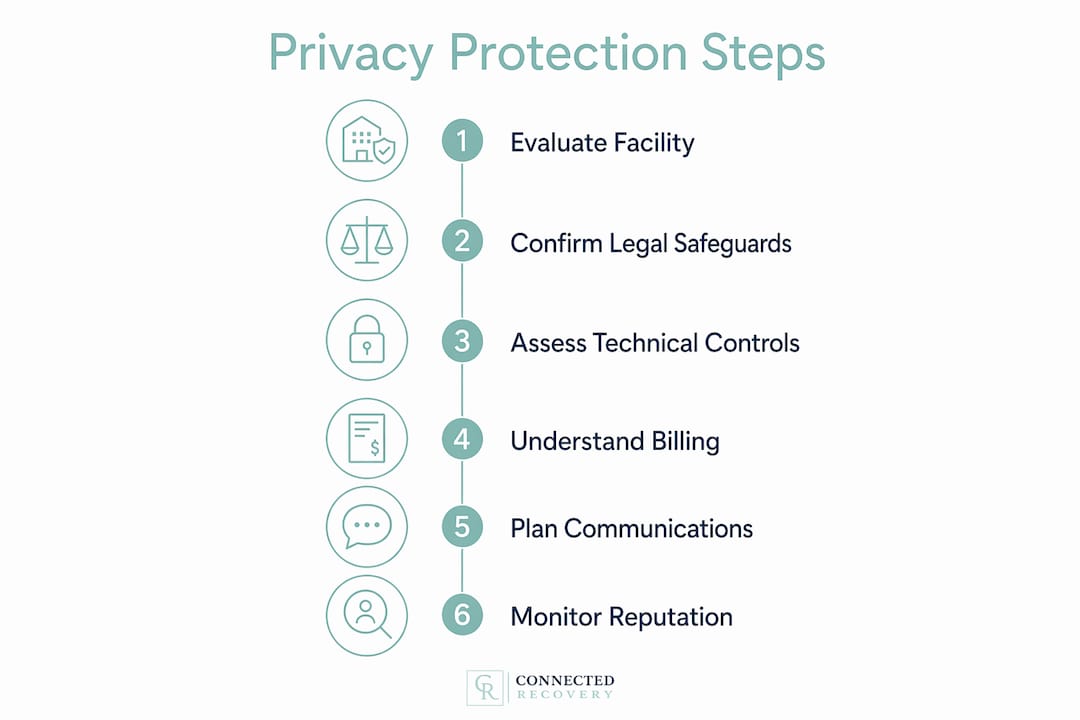
Insurance billing is where privacy most commonly breaks down for working professionals, and it is the area most people think about last.

When a claim goes through your insurer, an Explanation of Benefits (EOB) is generated. That document typically lists the provider name, dates of service, and diagnosis or procedure codes. If you are on an employer-sponsored plan, the EOB goes to the address on file — which could be your home, but the plan administrator at your company may also have access to aggregate claims data. Diagnosis codes for substance use disorders are specific enough that a knowledgeable HR professional could identify the nature of treatment.
Options that reduce this exposure:
- Private pay / cash pay: No claim is filed, no EOB is generated, and no insurer record exists. This is the cleanest option for privacy, though it requires out-of-pocket payment.
- Limited-disclosure invoices: Some facilities will issue invoices with general service descriptions rather than specific diagnosis codes. Ask explicitly whether this is available.
- FMLA leave: The Family and Medical Leave Act allows you to take up to 12 weeks of protected leave for a “serious health condition” without specifying the diagnosis to your employer. Your treating physician certifies the need for leave using general language. Insurance billing in rehab and FMLA coordination are topics worth discussing with your admissions coordinator before you sign anything.
Understanding rehabilitation coverage in private insurance can help you weigh the financial trade-offs between using benefits and paying privately.
Will your employer see that you went to rehab through your insurance? Possibly, if you use an employer-sponsored plan and the EOB reaches HR. Private pay eliminates that risk entirely. If you use insurance, ask the facility how the claim will be coded and whether they can use the least-specific code that still supports reimbursement.
Profession-specific protections: monitoring programs and licensing boards
For physicians, nurses, attorneys, pilots, and other licensed professionals, the reputational stakes of addiction treatment are highest — and the protections available are also most developed.
Physician Health Programs (PHPs) and their equivalents for lawyers, nurses, and other professions are designed around one core principle: rehabilitation first, discipline second. When a professional self-refers to a monitoring program before a complaint is filed, the program typically works confidentially with the licensing board to monitor compliance rather than triggering a public disciplinary proceeding. That distinction — self-referral versus incident-driven reporting — is the single largest factor in whether a professional’s treatment history becomes a public record.
Practical steps for licensed professionals:
- Contact your profession’s health or assistance program before entering treatment. Most states have a PHP, a Lawyers Assistance Program (LAP), or a Nurse Assistance Program (NAP) with confidential intake lines.
- Ask the monitoring program what documentation a treatment facility needs to provide and in what format — then confirm the rehab facility can produce it.
- Prepare a reintegration plan before discharge: what your return-to-work conditions are, what monitoring frequency is required, and who at the facility will coordinate with the program.
- Ask the monitoring program representative: “If I self-refer now, does this stay out of the public disciplinary record?” and “What triggers a mandatory report to the board?”
Pro Tip: Self-referral to a monitoring program is almost always more protective than waiting. Voluntary engagement with a PHP or LAP typically allows professionals to continue practicing under a monitoring agreement, while an incident-driven referral often triggers a public board action and mandatory disclosure.
When confidentiality can fail: the real limits you need to know
No privacy protection is absolute, and understanding the exceptions is as important as understanding the protections.
Circumstances where a facility may be required to disclose:
- Court order or subpoena: Both HIPAA and Part 2 can be overridden by a court order, though Part 2 requires a higher legal standard — a court must find that the public interest substantially outweighs the patient’s privacy interest. Even then, the facility’s legal counsel typically challenges overbroad subpoenas before complying.
- Imminent danger: If a clinician determines you pose an imminent threat to yourself or others, most states require or permit disclosure to prevent harm. This is a narrow exception, not a general mental-health reporting requirement.
- Mandatory child-abuse reporting: All states require licensed professionals to report suspected child abuse regardless of confidentiality protections. SUD treatment does not exempt a provider from this obligation.
- Medical emergencies: A facility can disclose the minimum necessary information to emergency responders when your life is at risk.
The re-disclosure rule under Part 2 is worth repeating here: even when a valid disclosure occurs, the recipient is prohibited from re-disclosing your SUD records to a third party unless your consent explicitly permits it. That prohibition travels with the records.
Practical risk mitigation:
- Before signing any release, ask the facility’s compliance officer what happens if they receive a subpoena for your records.
- Get legal advice before signing a broad release that names your employer or licensing board as a recipient.
- Understand that criminal justice referrals (court-ordered treatment) operate under a different consent framework — ask your attorney to review any court-ordered release language.
The criminal penalty structure for unauthorized disclosure gives facilities a strong incentive to challenge overbroad requests rather than comply reflexively.
Checklist: what to ask and verify at every stage
Before admission
- Does this facility operate under both HIPAA and 42 CFR Part 2?
- Is private-pay or cash-pay invoicing available, and how will invoices be described?
- What are your admissions privacy options (off-site intake, private transport, first-name-only protocols)?
- Who on staff will have access to my clinical record?
- Can I review your Notice of Privacy Practices before I arrive?
During treatment
- How will communication with my family or employer be handled, and what do I need to sign?
- What platform does your telehealth use, and is it HIPAA-compliant?
- How is my phone and internet use managed, and what does that mean for my records?
- If someone calls asking whether I’m a patient, what is your policy?
After discharge
- What documentation can you provide to a professional monitoring program or licensing board?
- What remains in my medical record, and who can request it after I leave?
- How do I set up ongoing communication with my aftercare coordinator while keeping my privacy intact?
Different treatment settings — residential, intensive outpatient, telehealth — carry different privacy trade-offs that are worth discussing with your admissions coordinator before you commit to a program type.
How Connected Recovery applies these protections in practice
Connected Recovery Inc. is a small boutique facility in Van Nuys, California, offering residential treatment and medical detox with 24/7 medical supervision. The small census is itself a privacy feature: with only 12 clients at any time, individualized attention is the norm, and the risk of running into a colleague is essentially zero.
Here is how the facility’s approach maps to the protections described above:
- Admissions: Intake can be initiated by phone, with private transport arrangements available. Clients are not required to use full names in group settings.
- Billing: Private-pay options are available, and the admissions team can walk you through how insurance claims will be coded before you decide whether to use benefits.
- EHR and records: SUD records are maintained under Part 2 protocols, with role-based staff access and consent-tracking workflows.
- Professional coordination: The clinical team can coordinate directly with Physician Health Programs, Lawyers Assistance Programs, and other monitoring bodies to produce the documentation those programs require — and to do so without disclosing more than the program needs.
- Aftercare: Discharge planning includes coordination with monitoring programs and aftercare planning that accounts for return-to-work conditions.
At a boutique facility, privacy is not a policy add-on — it is a structural feature. A small number of beds means individualized records and consent forms, and a clinical team small enough that every staff member knows exactly what they are and are not authorized to share.
For specific questions about Connected Recovery’s privacy practices, the admissions team can walk you through the facility’s Notice of Privacy Practices before you commit to anything.
What you can do if your privacy is breached
Knowing your recourse matters as much as knowing your protections.
If you believe a facility disclosed your information without valid consent, your first step is to file a complaint with the HHS Office for Civil Rights (OCR). OCR investigates HIPAA violations and can impose civil monetary penalties. For Part 2 violations, complaints can go to OCR or to the Substance Abuse and Mental Health Services Administration (SAMHSA). You also retain the right to request an accounting of disclosures — a record of every time your information was shared and with whom — under HIPAA’s patient rights framework.
Beyond federal complaints, you may have a state-law claim. Many states have their own health privacy statutes with independent enforcement mechanisms and, in some cases, private rights of action that allow you to sue for damages. Consulting a health privacy attorney is the fastest way to understand which avenue applies to your situation.
Practical steps after a suspected breach:
- Document everything: dates, what was disclosed, to whom, and how you learned about it.
- Request the facility’s breach notification in writing — HIPAA requires notification within 60 days of discovery.
- Contact an attorney before filing a complaint if the breach has professional licensing implications, since the sequence of actions can affect your options.
State laws add another layer of protection
HIPAA and 42 CFR Part 2 are federal floors, not ceilings. Many states have enacted privacy laws that are stricter, and they apply on top of federal requirements.
California’s Confidentiality of Medical Information Act (CMIA), for example, imposes requirements beyond HIPAA and gives patients a private right of action for unauthorized disclosures. New York’s Mental Hygiene Law adds protections specific to substance use treatment records. Texas, Florida, and several other states have their own SUD-specific confidentiality statutes. When a state law is more protective than federal law, the state law governs.
What this means practically: the facility you choose should be able to tell you which state laws apply to your records and how those laws interact with HIPAA and Part 2. If a facility’s privacy officer cannot answer that question, that is a signal worth taking seriously. The California Department of Health Care Services publishes guidance on SUD record confidentiality that illustrates how state-level rules can exceed federal baselines.
How to communicate with employers, licensing boards, and professional organizations
The way you frame your treatment to external parties matters as much as the legal protections themselves.
With employers, the least-disclosure approach is usually best. FMLA certification requires only that your physician confirm a serious health condition and an expected duration of leave — not a diagnosis. Your HR department is not entitled to know the specific nature of your condition. If your employer asks directly, you are not legally required to disclose a substance use disorder diagnosis, and doing so voluntarily removes the protection you would otherwise have.
With licensing boards, the calculus is different. Most boards have specific questions on renewal applications about substance use treatment, criminal history, or mental health conditions. The safest approach is to answer those questions with the guidance of an attorney who specializes in professional licensing, not to guess. Many monitoring programs will help you draft compliant, accurate responses that satisfy the board’s requirements without volunteering more than necessary.
With professional organizations (medical societies, bar associations, nursing organizations), voluntary disclosure is almost never required and is rarely protective. The exception is when an organization runs its own assistance program — in that case, engaging with the program confidentially is usually more protective than avoiding it.
Monitoring your reputation after treatment
Leaving treatment is not the end of the privacy work. Ongoing monitoring protects against information surfacing in ways you did not anticipate.
Set up Google Alerts for your name and your professional credentials. This catches any public mention — a news article, a court filing, a licensing board notice — before it spreads. For professionals in regulated industries, check your licensing board’s public disciplinary database periodically to confirm no action has been filed without your knowledge.
If you used insurance and are concerned about what appears in your claims history, request a copy of your records from your insurer. Under HIPAA, you have the right to access your own health information. Review the diagnosis codes that were submitted and, if anything appears inaccurate, you have the right to request an amendment.
For longer-term reputation management, the lifelong recovery process includes building a track record of sustained sobriety that speaks for itself — monitoring program completion letters, return-to-work documentation, and peer references from colleagues who can speak to your professional performance post-treatment. That paper trail is often the most persuasive evidence available when a licensing board or employer has questions.
Key Takeaways
Voluntary treatment with proper legal and operational safeguards in place is almost always more protective of a professional’s reputation than waiting for an incident to force the issue.
| Point | Details |
|---|---|
| Federal law sets a strong floor | HIPAA and 42 CFR Part 2 together restrict disclosure, require written consent for SUD records, and prohibit re-disclosure without your authorization. |
| Self-referral to monitoring programs protects licensure | Professionals who contact a PHP, LAP, or NAP before an incident is reported typically avoid public disciplinary records. |
| Private pay eliminates insurer exposure | Cash payment means no EOB, no insurance claim, and no employer-accessible claims data — the cleanest privacy option available. |
| State laws may exceed federal protections | California, New York, and other states have SUD confidentiality statutes stricter than HIPAA; ask your facility which state rules apply. |
| Connected Recovery offers privacy-first intake | The 12-bed boutique facility provides private-pay options, role-based record access, and direct coordination with professional monitoring programs. |
The case for getting help before the crisis arrives
The conventional wisdom is that professionals wait — they manage, they compensate, they hope the problem resolves itself. What the evidence from professional monitoring programs actually shows is the opposite: proactive coordination with a PHP or LAP often keeps self-referred cases out of the public disciplinary record entirely, while late, incident-driven reporting is the primary driver of public board actions.
The fear of reputational damage is real, but it tends to be misdirected. The risk is not treatment — it is the untreated condition becoming visible through performance problems, a patient complaint, a DUI, or a colleague’s mandatory report. At that point, the professional has lost the one advantage that monitoring programs are specifically designed to preserve: the ability to self-define the narrative as someone who recognized a problem and addressed it.
Seeking help is not a career-ending move. For most licensed professionals who engage early and follow through, it is the opposite.
Connected Recovery offers confidential, professional-focused treatment
For professionals who need treatment without the exposure that comes with a large, high-visibility facility, Connected Recovery’s boutique model is worth a direct conversation. The 12-bed capacity means your care team is small, your records are handled by a limited number of staff, and your intake can be structured around your privacy needs from the first call.
Connected Recovery offers residential treatment and medical detox in Van Nuys, California, with private-pay options, FMLA coordination, and direct liaison with professional monitoring programs. The admissions team can walk you through the facility’s Notice of Privacy Practices, explain exactly how your records will be handled, and help you understand your options before you commit to anything. Call the admissions line or visit the website to request a confidential assessment — the conversation itself is protected.
Where to verify these claims and find authoritative documents
Authoritative sources for the legal and procedural claims in this article:
- HHS — HIPAA for Professionals: the primary federal source for HIPAA privacy rules and permitted disclosures.
- HHS — 42 CFR Part 2 Final Rule Fact Sheet: explains the 2024 rule changes, including the single TPO consent and anti-discrimination provisions.
- Federal Register — 2024 Part 2 Final Rule: the full regulatory text of the 2024 amendments.
- HHS — Patient Rights Under HIPAA: plain-language summary of your rights to access, amend, and obtain an accounting of disclosures.
- SAMHSA National Helpline: free, confidential, 24/7 referral service for substance use and mental health treatment.
- AMA Journal of Ethics — Physician Health Programs: peer-reviewed analysis of PHP structure and the self-referral advantage.
- California DHCS — SUD Licensing and Confidentiality: example of state-level SUD confidentiality requirements that exceed federal baselines.
- Connected Recovery — HIPAA Protections Explained: facility-specific explanation of how HIPAA applies in the rehab setting.
For questions about how these rules apply to your specific professional license or disciplinary situation, consult a health privacy attorney or contact your profession’s monitoring program directly — the legal nuances vary by state and by profession, and general information is not a substitute for advice tailored to your circumstances.
Recommended
- HIPAA Protections in Rehab Programs: Your Rights Explained | Connected Recovery Inc.
- How Insurance Billing Affects Rehab Privacy in 2026 | Connected Recovery Inc.
- Confidential Rehab Admission Process: Step-by-Step Guide | Connected Recovery Inc.
- Steps to Emergency Rehab Admission: Act Fast, Get Help | Connected Recovery Inc.
DHCS Licensed · Joint Commission Accredited
If you or a loved one is struggling with substance use, our admissions team is available to verify your insurance benefits and help you begin recovery. All calls are confidential.