
How to Navigate Insurance for Detox Coverage

Insurance coverage for detox services is a legal right under federal law, not a benefit your insurer can freely deny. The Mental Health Parity and Addiction Equity Act (MHPAEA) requires most health plans to cover substance use disorder treatment on the same terms as any other medical care. That means if your plan covers a five-day hospital stay for a cardiac event, it cannot impose stricter limits on a five-day medical detox. Knowing how to navigate insurance for detox coverage puts you in control before you ever pick up the phone. This guide walks you through federal protections, verification steps, pre-authorization, and what to do when a claim gets denied.
What federal laws require for detox coverage
Federal law is the foundation of every detox coverage conversation. The MHPAEA mandates comparable coverage for substance use disorder services and medical or surgical care across most employer-sponsored, marketplace, and Medicaid plans. That parity requirement is not optional. Insurers cannot apply tighter deductibles, higher copays, or stricter visit limits to addiction treatment than they apply to other acute medical hospitalizations.
The Affordable Care Act (ACA) reinforces this protection by classifying substance use disorder treatment as an Essential Health Benefit. That classification means marketplace plans and Medicaid must include detox, inpatient treatment, outpatient services, and medication-assisted treatment (MAT) in their coverage. Employer self-funded plans have more flexibility, but the MHPAEA still applies to most of them.
Understanding detox insurance means knowing what these laws actually cover. Common services included under detox coverage are:
- Medical supervision and 24/7 nursing care during withdrawal
- Physician assessments and daily monitoring
- Medications used to manage withdrawal symptoms, such as benzodiazepines or buprenorphine
- Lab work and vital sign monitoring
- Mental health evaluations for co-occurring conditions
Medicaid coverage varies by state. Medicaid often requires recipients to use in-state facilities and carries low or no copays, but not all private treatment centers accept it. State-funded programs and community health centers typically do. If you have a marketplace or employer plan, your detox program insurance is likely broader in terms of facility choice.
How do you verify your insurance benefits for detox?
Verification is the step most people skip, and it costs them. Before you commit to any detox program, you need a clear picture of what your plan actually pays. Follow these steps to get that picture accurately.
-
Gather your insurance card and policy documents. Locate your member ID, group number, and the behavioral health phone number listed on the back of your card. Many plans have a separate behavioral health department that handles addiction treatment claims.
-
Call the behavioral health line directly. Ask specifically about substance use disorder benefits, not just “mental health” coverage. The two are often handled differently in the system, even though the MHPAEA requires parity between them.
-
Ask the right questions. Get answers to all of the following before ending the call:
- What is my deductible, and how much have I met so far?
- What is my copay or coinsurance for inpatient detox?
- Is pre-authorization required for detox admission?
- How many days of detox does my plan cover per year?
- What is my out-of-pocket maximum?
-
Request written verification of benefits. Written proof of coverage documents exact costs and limitations. It also protects you if the insurer and the treatment center give you conflicting information later.
-
Search for in-network facilities. Use your insurer’s online provider directory and filter by behavioral health or substance use disorder treatment. In-network care reduces your out-of-pocket costs significantly.
-
Cross-check with the treatment center. Call the admissions team at your chosen facility and give them your insurance details. They will confirm what the insurer told you and flag any discrepancies before you arrive.
Pro Tip: Medical detox is typically covered at 80% or higher after your deductible under most commercial health plans. Ask your insurer for your current deductible balance so you know your exact out-of-pocket exposure before day one.
How does pre-authorization work for detox admission?
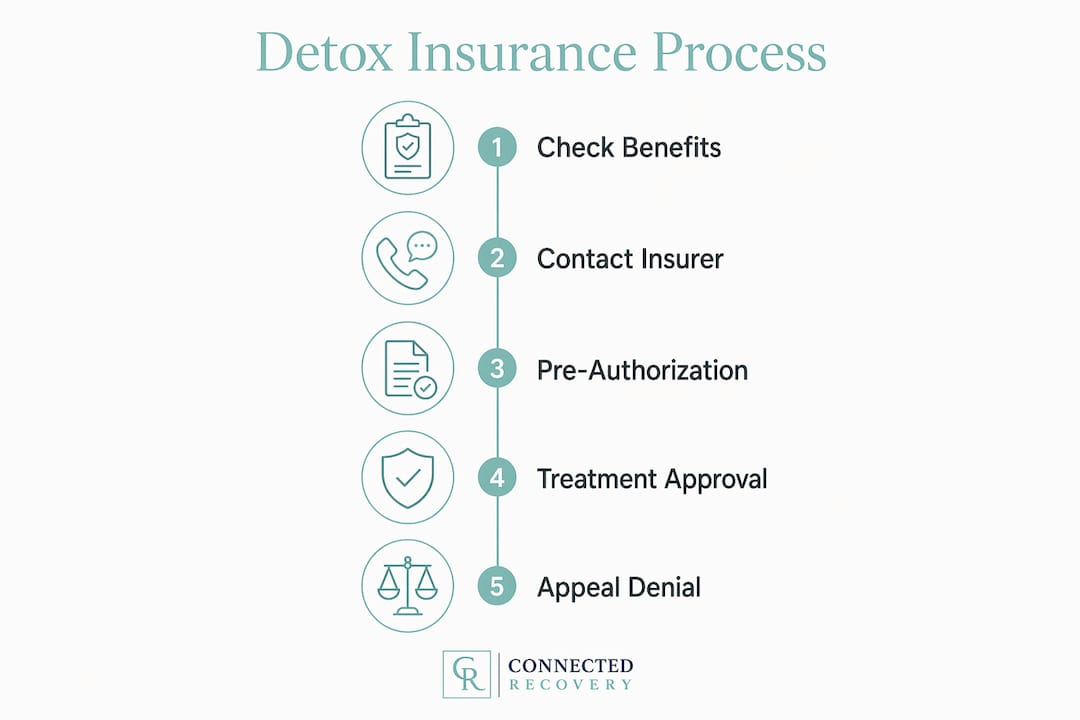
Pre-authorization is the insurer’s approval process before treatment begins. Most insurance plans require pre-authorization for detox and residential treatment. Without it, claims are often denied entirely, even when the treatment itself is medically necessary.
Here is what the pre-authorization process involves and where it can break down:
- Clinical documentation is required. A licensed physician or addiction specialist must submit records showing medical necessity. This includes a diagnosis, a description of withdrawal risk, and a treatment plan. Incomplete documentation is the most common reason for delays.
- The treatment center’s admissions team usually handles this. Experienced admissions staff know the specific billing codes and insurer contacts that speed up approval. Letting them manage the paperwork reduces errors and saves you hours on hold.
- Confirm who is filing before you arrive. Ask the admissions team directly: “Will you obtain pre-authorization on my behalf before my admission date?” Get that confirmation in writing or by email.
- Timing matters. Pre-authorization for a planned admission typically takes 24–72 hours. Emergency detox admissions may be authorized retroactively, but you should still notify your insurer within 24 hours of admission.
- Know who to call if there is a delay. If the treatment center has not received authorization within the expected window, contact your insurer’s behavioral health line and ask for the authorization department. Reference the case number the center provided.
Pro Tip: Treatment centers handle insurance verification faster than patients can because they know the exact behavioral health billing codes and direct insurer contacts. Let the admissions team take the lead on this step.
The detox stabilization phase is the period insurers scrutinize most closely when reviewing clinical necessity. Make sure the treatment center documents withdrawal severity and medical risk clearly in the pre-authorization request.

What are common coverage limits, and how do you appeal a denial?
Coverage limits are real, but they are not the final word. The most common restrictions you will encounter include day limits on inpatient detox, step-therapy requirements that push you toward outpatient care first, and copay increases after a set number of days. These limits are legal only if the insurer applies equivalent restrictions to comparable medical hospitalizations.
Denials happen for several reasons. The most frequent ones are:
- The insurer claims the treatment does not meet clinical criteria
- Pre-authorization was not obtained before admission
- The facility is out of network
- Documentation submitted was incomplete or used incorrect billing codes
When a denial arrives, read the explanation of benefits carefully. MHPAEA requires insurers to provide clear denial reasons and written appeal instructions. That requirement gives you a defined path forward.
Your right to appeal is protected by federal law. Under the MHPAEA and ACA, insurers must provide a full and fair review of any denied claim for substance use disorder treatment. If the denial is based on clinical criteria, you can request that the insurer disclose the specific criteria used and compare them to the criteria applied to medical or surgical claims.
To build a strong appeal:
- Obtain a letter of medical necessity from the treating physician
- Request the insurer’s clinical criteria used to deny the claim
- Compare those criteria to what the insurer applies to medical hospitalizations
- Submit all documentation in writing and keep copies of everything
- Follow up within the insurer’s stated appeal window, typically 30–60 days
If the internal appeal fails, you have the right to an external review by an independent organization. The safe detox environment your provider maintains, including 24/7 medical supervision and licensed clinical staff, directly supports the medical necessity argument in any appeal.
If coverage is denied and appeals are exhausted, ask the treatment center about sliding-scale fees, payment plans, or state-funded assistance programs. Many facilities have financial counselors who specialize in exactly this situation.
Key Takeaways
Federal law gives you strong rights to detox coverage, and knowing the verification and appeal process is the difference between getting care and getting stuck in paperwork.
| Point | Details |
|---|---|
| Federal law mandates parity | MHPAEA requires insurers to cover detox on the same terms as other acute medical care. |
| Verify benefits before admission | Call the behavioral health line, ask specific questions, and get written confirmation of coverage. |
| Pre-authorization is required | Most plans require prior approval; let the treatment center’s admissions team handle the filing. |
| Denials are frequently appealable | Request the insurer’s clinical criteria and submit a physician letter of medical necessity to challenge denials. |
| Written verification protects you | Documented benefit details resolve disputes between insurers and treatment centers before they become problems. |
What I’ve learned from watching people fight for detox coverage
Most people I have seen struggle with insurance for detox made the same mistake: they called their insurer first, got a vague answer, and either gave up or showed up to treatment without pre-authorization. Both outcomes are avoidable.
The single most effective move is to find a treatment center you trust, then let their admissions team run the insurance verification. Admissions teams know specific contact numbers and billing codes that get answers faster than a general member services call ever will. You are not cutting corners by delegating this. You are using the system correctly.
The other thing I want people to understand is that the law is genuinely on your side. The MHPAEA is not a soft guideline. It is a federal mandate with real teeth. If your insurer is applying stricter limits to detox than to a comparable medical admission, that is a violation you can challenge. Do not accept a denial as the final answer without reading the appeal instructions the insurer is legally required to provide.
Get everything in writing. A verbal confirmation from a member services representative means nothing if the claim is denied later. Written verification of benefits is your paper trail, and it has resolved more billing disputes than any phone call ever could.
— Jim
Connected Recovery’s approach to insurance for detox
Connected Recovery’s medical detox program accepts many major insurance plans and has an experienced admissions team that handles the full verification and pre-authorization process on your behalf.

Connected Recovery operates as a 12-bed boutique facility in Van Nuys, CA, which means every person receives individualized attention from licensed clinical staff with 24/7 medical supervision. The admissions team verifies your detox program insurance coverage before your arrival date, so you know your financial responsibilities before treatment begins. For people managing co-occurring mental health conditions alongside substance use, Connected Recovery also offers dual diagnosis treatment with integrated insurance support. Reach out to the admissions team directly to get your benefits verified and your questions answered.
FAQ
Is detox covered by insurance?
Yes. Federal law under MHPAEA requires most health plans to cover detox services on the same terms as other acute medical care, including employer-sponsored, marketplace, and Medicaid plans.
How many days of detox does insurance typically cover?
Medical detox typically lasts 3–7 days and is covered at 80% or higher after your deductible under most commercial health plans. The exact number of covered days depends on your specific plan and clinical necessity.
What happens if my insurance denies my detox claim?
You have the right to appeal. MHPAEA requires insurers to provide written denial reasons and appeal instructions. Submit a physician letter of medical necessity and request the clinical criteria the insurer used to deny the claim.
Do I need pre-authorization before starting detox?
Most plans require it. Contact your insurer’s behavioral health line or let the treatment center’s admissions team file for pre-authorization on your behalf before your admission date.
Does Medicaid cover detox treatment?
Medicaid covers detox as part of its substance use disorder benefits, but Medicaid often requires recipients to use in-state facilities. Not all private treatment centers accept Medicaid, so confirm acceptance before choosing a facility.
Recommended
DHCS Licensed · Joint Commission Accredited
If you or a loved one is struggling with substance use, our admissions team is available to verify your insurance benefits and help you begin recovery. All calls are confidential.