Blog
Sleep Problems in Rehab: Recovery-Focused Steps That Avoid Sedative Risk
Sleep Problems in Rehab: Recovery-Focused Steps That Avoid Sedative Risk

Sleep problems in rehab are close to universal, not a sign that something is wrong with you specifically. They raise relapse risk and lower the odds of finishing treatment, which is exactly why clinicians treat sleep as a priority rather than an afterthought. The right first response is behavioral, not pharmaceutical: cognitive behavioral therapy for insomnia (CBT-I), consistent sleep hygiene, and a same-day screen for medical sleep disorders, and sedative medications like benzodiazepines reserved for short-term, closely supervised use.
TL;DR:
- Sleep problems during rehab often involve multiple symptoms like trouble falling asleep, fragmented sleep, early awakening, and daytime grogginess, which vary by substance withdrawal.
- Withdrawal from alcohol, sedatives, stimulants, and opioids all disrupt sleep architecture differently, with as many as 92% experiencing disturbed sleep during alcohol withdrawal alone.
- Untangling biological, circadian, and environmental factors helps explain why sleep difficulties persist weeks into recovery, especially without proper treatment or re-synchronization efforts.
- Behavioral interventions such as CBT-I and sleep hygiene should be prioritized over medication, with sedatives only used short-term under close medical supervision if necessary.
- Consistent wake times, morning light, and sleep tracking can significantly improve sleep, but certain issues like sleep apnea or restless leg syndrome require medical evaluation for proper treatment.
Table of Contents
- What Sleep Problems Look Like in Rehab and Early Recovery
- Why Sleep Falls Apart During Rehabilitation
- How Poor Sleep Undermines Treatment Completion
- Treating Sleep Problems Safely During Recovery
- A Step-by-Step Sleep Plan You Can Start This Week
- When Sleep Problems Need a Medical Evaluation
- How Connected Recovery Manages Sleep During Detox and Residential Care
- Why Sleep Deserves More Attention Than Rehab Programs Usually Give It
- Getting Supervised Help for Sleep and Substance Use Together
- Sources
What Sleep Problems Look Like in Rehab and Early Recovery
Sleep during early recovery rarely looks like a single problem. It shows up as a cluster of symptoms that shift depending on the week and the substance involved.
- Trouble falling asleep, sometimes lying awake for hours despite exhaustion
- Frequent awakenings, with the night broken into fragments instead of one stretch
- Waking too early and being unable to fall back asleep
- Sleep that technically happens but leaves you groggy and unrested
- Vivid, unsettling dreams or full nightmares, especially in the first weeks
- Daytime sleepiness that makes group sessions and therapy hard to focus on
The pattern often tracks the substance. Alcohol withdrawal frequently triggers REM rebound, a surge of dream-heavy sleep that produces the nightmares many people report in the first one to two weeks. Stimulant withdrawal tends to swing sleep timing unpredictably, crashing into hypersomnia one day and insomnia the next. Opioid and sedative withdrawal disrupts sleep architecture directly, cutting into the deep, slow-wave stages that make sleep feel restorative. Reviews on alcohol recovery and sleep put the prevalence of disturbed sleep during withdrawal as high as 92%. Problems commonly persist well into abstinence.
Why Sleep Falls Apart During Rehabilitation
Sleep problems in rehab come from at least three overlapping sources, and untangling them helps explain why the issue doesn’t resolve as fast as people expect.
The first is acute withdrawal itself. Alcohol and sedatives suppress GABA activity and REM sleep during use, so stopping triggers a rebound: GABA signaling swings the other way, and REM pressure spikes, producing lighter, more fragmented sleep and vivid dreaming. Dopamine pathways involved in reward and arousal also take time to recalibrate, and that recalibration doesn’t follow a tidy timeline. Some people feel their sleep improve in the first week; for others, the roughest stretch comes two to four weeks in, once acute withdrawal has passed and the brain is still resetting its baseline chemistry.
The second is circadian disruption. Years of substance use often desynchronize the body’s internal clock from the actual day/night cycle, and simply removing the substance doesn’t automatically re-sync it.
The third is the setting. Fixed wake times, shared rooms, hallway noise, unfamiliar mattresses, and anxiety about “sleeping right” all compound the biology. A qualitative study on sleep in residential treatment found that residents often struggle to align their internal rhythm with institutional schedules, and that mismatch breeds self-blame and nighttime performance anxiety that makes falling asleep even harder.
Pro Tip: If you’re lying awake worrying about not sleeping, that worry is often a bigger obstacle than the original insomnia. Naming it as “sleep effort anxiety” to staff can shift the conversation from “what’s wrong with me” to “what’s the next step.”
How Poor Sleep Undermines Treatment Completion
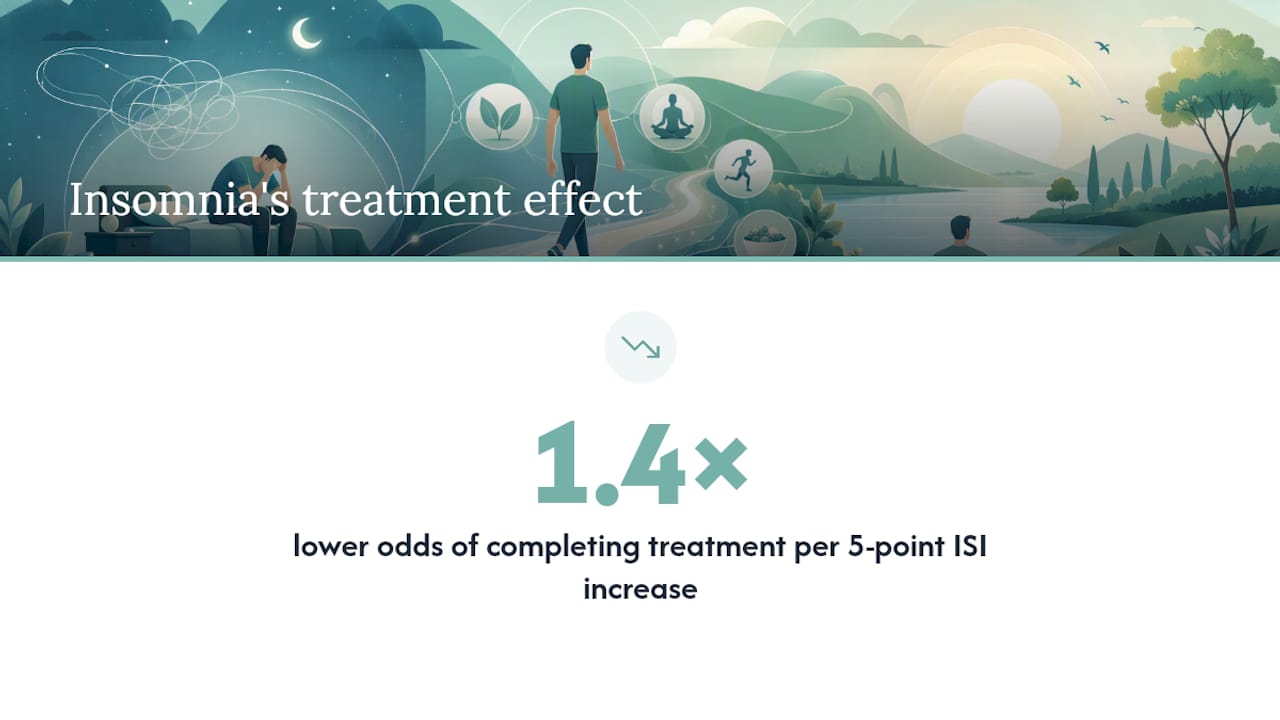
The connection between sleep and outcomes isn’t theoretical. A chart review of adults in an intensive outpatient program found that every 5-point increase in Insomnia Severity Index (ISI) score was associated with 1.4 times lower odds of completing treatment. That’s a meaningful drop for a 5-point shift on a scale that runs from 0 to 28.
Sleep disturbance functions as a modifiable risk factor for relapse, not just an uncomfortable side effect of withdrawal, according to a perspective on sleep and relapse.
The mechanism isn’t mysterious. Poor sleep intensifies cravings, weakens emotional regulation, and makes the coping skills taught in therapy harder to access exactly when they’re needed most. Someone running on four hours of fragmented sleep has less capacity to sit through a difficult group session or resist an urge during a stressful call home.
Watch for a specific warning sign: if daytime sleepiness is making you disengage from sessions, skip activities, or feel too irritable to participate honestly, that’s not just discomfort. It’s a signal that sleep itself has become a barrier to the work of recovery, and it’s worth raising with clinical staff directly rather than waiting it out.
Treating Sleep Problems Safely During Recovery
The evidence points in one clear direction: behavioral treatment first, medication only with real caution. CBT-I has shown benefit in trials involving people with substance use disorders, and clinical reviews recommend it as the first-line approach when it’s available, even in brief or group-adapted formats.
A workable toolkit looks like this:
- Stimulus control: use the bed only for sleep, so your brain stops associating it with lying awake and frustrated
- Sleep scheduling: a fixed wake time, even after a bad night, to rebuild a stable circadian anchor
- Relaxation training: progressive muscle relaxation or paced breathing to lower the physiological arousal that keeps insomnia going
- Morning light exposure: getting outside or near a window early in the day to help reset a desynchronized internal clock
- Brief, group-friendly CBT-I modules, which can be built into intensive outpatient programming when one-on-one CBT-I isn’t staffed
Medication decisions deserve more scrutiny than they usually get. Benzodiazepines and other benzodiazepine receptor agonists carry real cross-dependence risk for someone already working through substance use, and clinical guidance consistently recommends avoiding them when other options exist. When a short-term medication strategy is genuinely necessary, it belongs under direct medical supervision, ideally within a program offering medical detox oversight rather than as a self-managed fix.
Sleep problems rarely travel alone. Depression, PTSD, and chronic pain all disrupt sleep independently, and treating the co-occurring condition often does more for sleep than treating insomnia in isolation. Screening for obstructive sleep apnea and restless leg syndrome matters too, since both mimic ordinary insomnia but need entirely different treatment; this highlights the importance of substance abuse screening benefits for treatment centers in a comprehensive recovery plan.
Pro Tip: If a sedating medication is offered, ask specifically whether it’s benzodiazepine-based and what the exit plan looks like before you start it. A short-term plan without a tapering strategy is a bigger risk than the insomnia itself.
A Step-by-Step Sleep Plan You Can Start This Week
This routine works whether you’re in residential treatment now or navigating early recovery on your own.
- Wake up at the same time every day, weekends included, even after a rough night. This is the single most reliable anchor for resetting circadian rhythm.
- Get morning light within 30 minutes of waking, ideally outside. Even five minutes on a patio helps signal “daytime” to your brain.
- Cut caffeine and nicotine by early afternoon. Both linger in your system far longer than most people assume.
- Build a 30 to 60 minute wind-down before bed: dim lights, no screens, and a repeatable relaxation exercise like paced breathing.
- Cap naps at 20 minutes and only before 3 p.m., so daytime sleep doesn’t cannibalize nighttime sleep drive.
- Track nights using a simple sleep diary or the ISI, and bring the pattern to staff if scores stay elevated for more than two weeks.
| Habit | Why it matters | Adaptation for residential settings |
|---|---|---|
| Fixed wake time | Rebuilds circadian stability | Ask staff about a quiet-hour arrangement if room noise conflicts with programming |
| Screen curfew | Reduces light-driven alertness before bed | Trade phone time for a paper journal or reading in common areas |
| Relaxation practice | Lowers pre-sleep arousal | Group-led breathing exercises can substitute for solo practice |
| Sleep diary tracking | Flags patterns worth escalating | Share entries with your counselor during check-ins |
Residential facilities built around structured daily routines tend to make this plan easier to follow, since the wake times and light exposure are already built into the schedule rather than left to willpower.
When Sleep Problems Need a Medical Evaluation
Most sleep disruption in early recovery resolves with time and behavioral treatment. Some patterns need a closer look sooner.
- Loud snoring, gasping, or witnessed pauses in breathing during sleep, which suggest sleep apnea
- An urge to move the legs at night that disrupts falling asleep, a hallmark of restless leg syndrome
- Insomnia that stays severe and unrelenting past several weeks despite consistent effort
- Unusual nighttime behaviors like sleepwalking or acting out dreams
- Any thoughts of self-harm tied to exhaustion or despair, which need immediate attention
Evaluation typically starts with a questionnaire like the ISI or the Pittsburgh Sleep Quality Index, then escalates if needed. The American Academy of Sleep Medicine outlines a tiered approach, from home ambulatory monitoring up to full in-lab polysomnography, depending on what the initial screen suggests. Objective testing matters more in this population than people realize, since reviews of sleep in substance use disorders have found that self-reported sleep complaints don’t always match what monitoring equipment picks up. Treating an underlying disorder like apnea often improves recovery engagement dramatically, because it removes a physical cause that behavioral techniques alone can’t fix.
How Connected Recovery Manages Sleep During Detox and Residential Care
Some residential treatment facilities build their models around smaller capacities specifically to keep this kind of individualized monitoring realistic. Larger facilities can’t easily track who’s still awake at 2 a.m. and why; smaller ones can.
- 24/7 medical supervision during detox, so any short-term sleep medication decisions happen under direct clinical oversight rather than guesswork
- Integrated dual diagnosis care, addressing mental health conditions that may drive sleep disruption alongside substance use
- Individualized treatment planning that can incorporate CBT-I-based techniques and structured daily schedules rather than a one-size routine
- Long-term aftercare planning to support ongoing recovery and sleep strategies after discharge
Readers weighing whether a residential treatment setting or supervised medical detox makes sense can use these same questions about sleep monitoring and medication caution as a checklist for any facility they’re considering.
Why Sleep Deserves More Attention Than Rehab Programs Usually Give It
The conventional advice on sleep problems in rehab tends to treat them as a phase to wait out, something that improves once withdrawal passes and the body settles down. That’s only half true. Acute symptoms do fade, but the ISI data on treatment completion suggests something sharper: insomnia that lingers past the first couple weeks is actively working against the recovery process, not just making it uncomfortable.
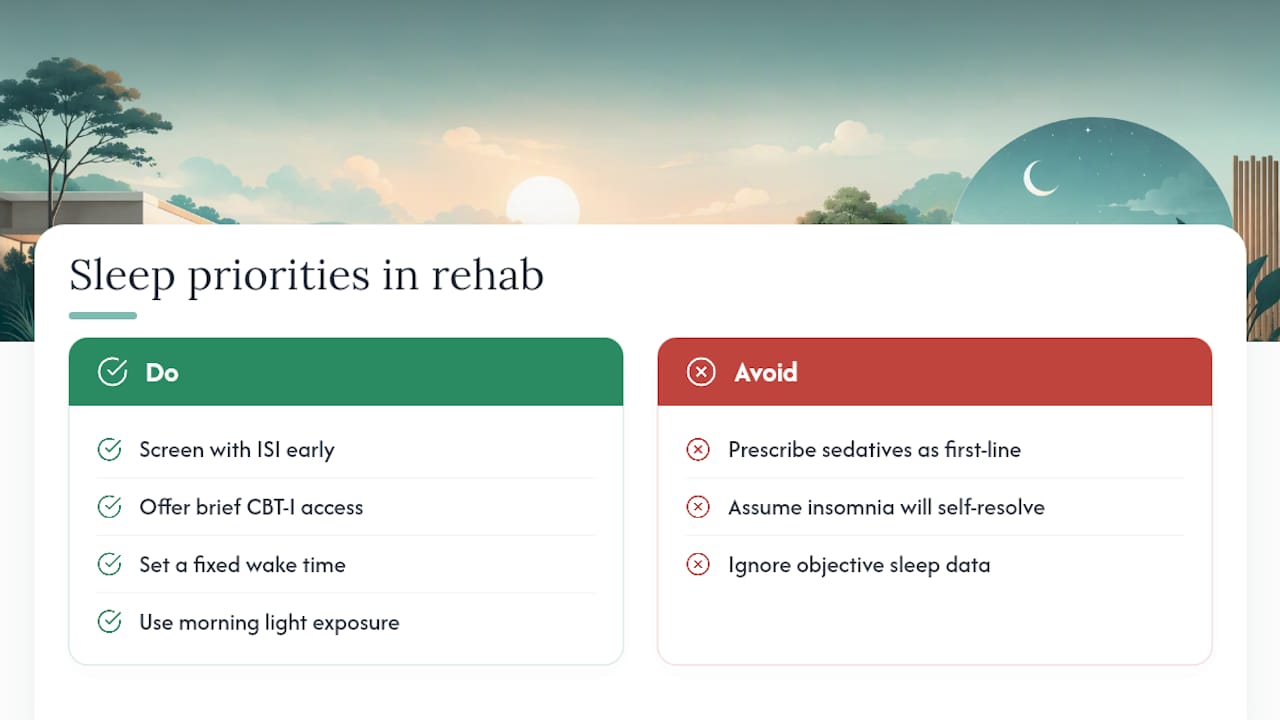
What’s overrated is the instinct to reach for a sedative as a quick fix. It solves tonight’s problem while quietly building tomorrow’s, given how easily cross-dependence forms in this population. What’s underrated is the boring stuff: a fixed wake time, morning light, and a sleep diary that gives you and your clinical team an actual pattern to work from instead of a vague sense that “sleep has been bad.”
If there’s one priority worth taking from the research, it’s this: treat sleep disruption as a clinical issue from day one, not a personal failing to push through. Ask for an ISI screen early. Push for CBT-I access, even a brief version, before accepting a sleep medication as the default. The people who stabilize fastest are usually the ones who stopped treating exhaustion as something to just tolerate.
— Jim
Getting Supervised Help for Sleep and Substance Use Together
If sleep has been the hardest part of quitting, you don’t have to sort withdrawal-driven insomnia out on your own or guess at what’s safe to take. Connected Recovery is built around exactly this problem: a 12-bed setting small enough that medical staff notice when someone isn’t sleeping, and structured enough that mornings have a fixed wake time and evenings have a real wind-down, not just an unlocked door and a lights-out announcement.

That combination matters most in the first two weeks, when withdrawal-related sleep disruption is at its worst and the wrong medication choice can create a second problem on top of the first. Connected Recovery’s medical detox program keeps any short-term sleep medication decision under 24/7 clinical supervision, and its dual diagnosis care addresses the depression, anxiety, or PTSD that’s often driving the insomnia rather than treating sleep as an isolated symptom. If you’re currently in rehab and sleep is derailing your progress, or you’re preparing to start treatment and want a program that takes this seriously from day one, reach out to Connected Recovery to discuss admission.
This article is general information, not a substitute for advice from a qualified doctor. Consult a qualified healthcare professional about your own circumstances before acting on anything here.
Sources
- Treatment Options for Sleep Disturbances During Alcohol Recovery
- Objective sleep outcomes in randomized-controlled trials in persons with substance use disorders: A systematic review
Recommended
DHCS Licensed · Joint Commission Accredited
If you or a loved one is struggling with substance use, our admissions team is available to verify your insurance benefits and help you begin recovery. All calls are confidential.