
Why Structured Daily Routines Aid Recovery

Structured daily routines reduce relapse risk by replacing unstructured hours with predictable anchors that lower anxiety, cut decision fatigue, and rebuild the self-trust that addiction erodes. That is the short answer, and the research backs it up. People in early recovery often gain 16–18 hours of newly unstructured time that used to be filled by substance-seeking, and without intentional structure, those hours become the highest-risk windows of the day.
Here is what routines actually do, in plain terms:
- Reduce prediction error. A predictable day lowers the brain’s constant threat-scanning, which directly cuts baseline anxiety.
- Stabilize sleep. Consistent sleep and wake times anchor circadian rhythms and improve mood and impulse control.
- Fill the vacuum. Structured activity crowds out idle time where cravings take hold.
- Automate medication and appointments. When a task is scheduled, it no longer requires willpower to initiate.
Start there. Pick a wake time, a meal, or a short walk, and commit to it for the next seven days. Everything else in this guide builds from that first anchor.
Table of Contents
- Why routines work the way they do in your brain
- Eight concrete benefits routines produce in recovery
- How long does it actually take for new habits to stick?
- How to build a daily routine that actually holds
- What do real daily schedules look like?
- Common obstacles and how to work around them
- How to tell if your routine is helping
- What the research actually says
- Key Takeaways
- A clinical perspective on structure and recovery
- Connected Recovery can help you build structure from day one
- Useful sources and further reading
Why routines work the way they do in your brain
The brain in early recovery is running on depleted dopamine, impaired prefrontal function, and a nervous system that has been calibrated to expect chemical reward. Predictability is not just comforting in that state. It is neurologically protective.

When your day follows a consistent pattern, the brain generates fewer prediction errors, the mismatch signals that fire when reality does not match expectation. Fewer prediction errors mean less threat-scanning, lower cortisol, and a calmer baseline. That calm is not a luxury in recovery. It is the physiological condition under which cravings are manageable rather than overwhelming.
Behaviorally, routines work by reducing decision fatigue. Every small choice, what to eat, when to leave, whether to call someone, draws on the same finite pool of cognitive resources. A pre-planned schedule removes dozens of those micro-decisions per day, conserving mental energy for the harder therapeutic work: processing trauma, attending groups, rebuilding relationships. Practitioners sometimes describe this as “freedom by automation,” and the framing is accurate.
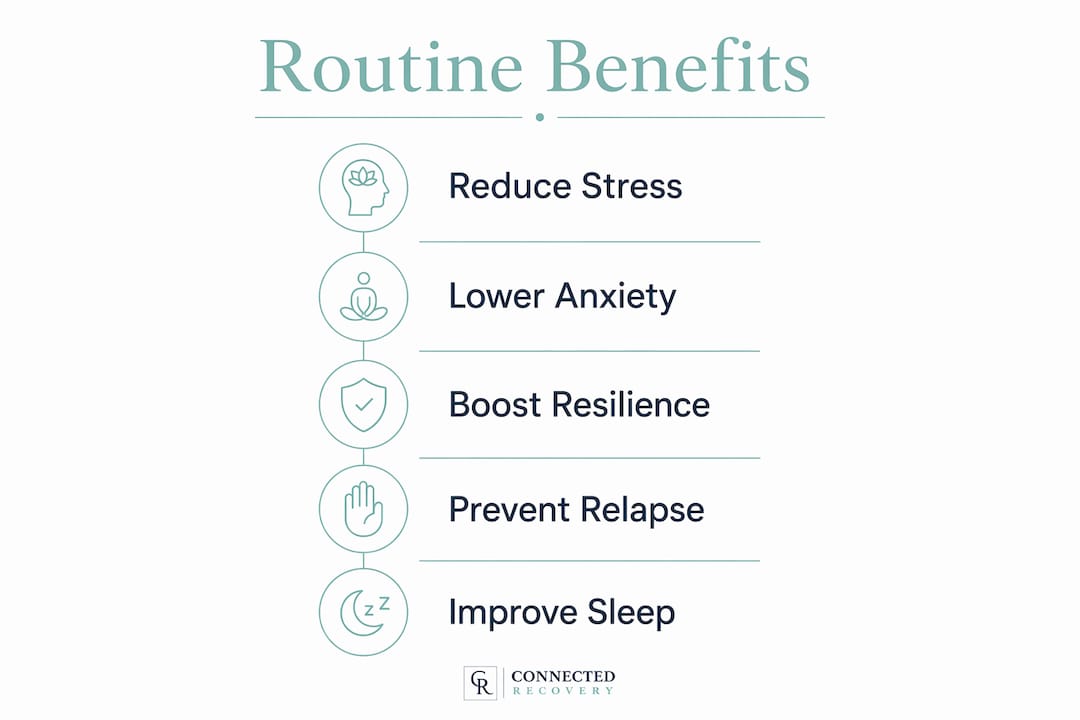
The third mechanism is the most underappreciated: routines fill time. Research on time use in early recovery shows that abstinence creates a large daily vacuum that, left unfilled, becomes a direct relapse risk. Structure is not about control for its own sake. It is about replacing a high-risk vacuum with low-risk activity.
Pro Tip: Set your morning anchor at the same time on weekends. The brain does not distinguish between Tuesday and Saturday, and weekend schedule drift is one of the most common early-recovery relapse triggers.
Statistic callout: People who maintained structured routines during high-stress periods showed higher psychological resilience and lower anxiety and depression scores compared to those without consistent daily structure.
Eight concrete benefits routines produce in recovery
Structured routines do not just feel stabilizing. They produce measurable changes across multiple domains of recovery. Here are the most clinically significant ones:
- Reduced relapse windows. Filling unstructured time with scheduled activity directly shrinks the hours when cravings go unchecked. Time-use research confirms that unoccupied time is a primary risk factor in early recovery.
- Better sleep quality. Irregular sleep timing worsens anxiety and mood instability even when total sleep hours stay the same. A consistent bedtime and wake time stabilizes the circadian system that governs mood and impulse control.
- Stabilized mood. Predictable daily rhythms reduce cortisol variability, which smooths out the emotional peaks and troughs that make early recovery feel chaotic.
- Improved medication adherence. Tying medication to a fixed daily anchor, such as breakfast, dramatically improves consistency. For people in medication-assisted treatment, timing regularity is clinically significant.
- Increased social contact and accountability. Scheduling recovery meetings, check-ins, or shared meals builds social anchors that double as accountability structures.
- More meaningful daily activity. Habits and routines research found that participants in early recovery reported structured days improved their sense of purpose and daily functioning.
- Reduced decision fatigue. Automating small daily tasks preserves cognitive resources for therapeutic work, a benefit that compounds over weeks.
- Brief daily movement improves mood. Short aerobic activity, even a 20-minute walk, provides measurable mental health benefits and reduces depressive symptoms.
For a deeper look at how these benefits connect to a broader care plan, the recovery support resources guide at Connected Recovery covers community and clinical options worth building into a daily schedule.
How long does it actually take for new habits to stick?
The honest answer is: longer than most people expect, and faster than most people fear, depending on what you measure.
Early wins come quickly. Within the first two weeks of a consistent routine, most people notice reduced morning anxiety and a clearer sense of what the day holds. That is not habit formation yet. That is the relief of reduced uncertainty. Real habit formation, where a behavior becomes automatic and requires minimal conscious effort, takes considerably longer.
Statistic callout: Research on habits and routines in early recovery found that repetition and consistency were the primary factors participants linked to positive outcomes, reinforcing that frequency matters more than intensity in the early stages.
The most practical framework for recovery-oriented habit building works in three stages:
- Weeks 1–2: Pick one or two anchors only. A consistent wake time and a scheduled meal are enough. The goal is not a full schedule. The goal is proof to yourself that you can repeat something.
- Months 1–3: Add one new anchor per week once the first two feel automatic. This is where habit-stacking works well: attach the new behavior to an existing anchor. Morning medication after coffee. A short walk after lunch. Recovery contact before dinner.
- Months 6–12: The routine becomes background infrastructure. The focus shifts from maintaining structure to adjusting it as life circumstances change, work, relationships, new responsibilities.
The two-minute rule is worth borrowing here: if a new habit feels hard to start, shrink it to two minutes. A two-minute walk is still a walk. A two-minute journal entry is still a journal entry. Starting is the hardest part, and a tiny version of the behavior still fires the neural pathway you are trying to build.
Pro Tip: Never try to build more than two new habits simultaneously. The research on habit formation consistently shows that stacking too many changes at once leads to abandonment of all of them. One anchor at a time, repeated until it is boring, then add the next.
How to build a daily routine that actually holds
Building a routine that survives real life requires more than a schedule template. It requires designing for the moments when motivation is lowest.

Step 1: Choose your anchors first. Anchors are the non-negotiable time markers that hold the rest of the day in place. Start with wake time, one meal, and one recovery-related contact. Everything else is optional until these three are stable.
Step 2: Schedule medications and appointments before anything else. These are non-discretionary. Put them in a phone calendar with an alarm. Consistent medication timing is not a preference in recovery. It is a clinical requirement for many treatment protocols.
Step 3: Block transition times. The gaps between activities are where routines collapse. A 10-minute buffer between waking up and leaving the house, or between work and an evening meeting, prevents the rushed, reactive state that triggers cravings.
Step 4: Add one low-friction enjoyable activity per day. Recovery is not only about removing harmful behavior. It is about building a life worth staying sober for. A short walk, a meal with someone you trust, or 15 minutes of something you enjoy creates positive reinforcement for the structure itself.
Step 5: Use the simplest possible tracking system. A paper checklist on the refrigerator works as well as any app. The goal is a daily visual record of adherence, not a productivity system. Check off anchors completed. Review weekly, not daily, to avoid over-scrutiny.
Here is a sample framework to adapt:
Morning anchors (7:00–9:00 AM)
- Wake at the same time, including weekends
- Brief movement (10–20 minutes)
- Breakfast and medication if applicable
- One grounding activity: journaling, reading, or a short call
Afternoon structure (12:00–5:00 PM)
- Scheduled meal at a consistent time
- Work, therapy, or structured activity
- Recovery contact or meeting if scheduled
Evening wind-down (8:00–10:00 PM)
- Light activity only: no screens 30 minutes before bed
- Consistent bedtime
- Brief review of tomorrow’s anchors
Pro Tip: Build a “weekend flex rule” into your routine from the start. Allow yourself to shift non-critical anchors by up to 60 minutes on weekends, but keep wake time and medication timing fixed. This prevents the all-or-nothing thinking that turns one lazy Sunday into a collapsed week.
Community in sustained recovery is one of the strongest anchors available. Scheduling a meeting, a check-in call, or a shared meal with someone in recovery is not optional social activity. It is a clinical-grade protective factor.
What do real daily schedules look like?
Two realistic templates follow. Neither is prescriptive. Both are starting points.
Early recovery schedule (first 90 days)
| Time | Activity | Purpose |
|---|---|---|
| 6:30 AM | Wake, brief stretch | Circadian anchor |
| 7:00 AM | Breakfast + medication | Adherence + fuel |
| 8:00 AM | Morning meeting or call | Accountability anchor |
| 10:00 AM | Structured activity (therapy, job search, chores) | Fills high-risk morning hours |
| 12:30 PM | Lunch | Meal anchor |
| 2:00 PM | Low-intensity movement | Mood regulation |
| 4:00 PM | Therapy or group session | Clinical anchor |
| 6:00 PM | Dinner with support person | Social anchor |
| 8:00 PM | Wind-down: reading, light journaling | Transition to sleep |
| 9:30 PM | Lights out | Sleep anchor |
Maintenance schedule (6+ months)
| Time | Activity | Purpose |
|---|---|---|
| 7:00 AM | Wake, coffee, brief movement | Morning anchor |
| 8:00 AM | Work or structured obligation | Daytime structure |
| 12:00 PM | Lunch | Meal anchor |
| 5:30 PM | Exercise or outdoor activity | Mood and energy |
| 7:00 PM | Dinner | Social or solo anchor |
| 8:30 PM | Recovery meeting or check-in (3x/week) | Accountability |
| 10:00 PM | Wind-down, consistent bedtime | Sleep anchor |
A few adaptation notes worth keeping in mind:
- Shift workers: Anchor to your wake time relative to your shift, not to a clock time. The circadian benefit comes from consistency, not from waking at 7:00 AM specifically.
- Parents with young children: Build anchors around your child’s schedule. Their routine becomes yours. Morning school drop-off and evening bedtime are ready-made anchors.
- Irregular obligations: Protect your sleep anchor above all others. If the rest of the day is chaotic, a consistent bedtime and wake time still provide meaningful circadian stability.
Test any new schedule for two to four weeks before adjusting it. Most people abandon a routine after three days because it feels uncomfortable, not because it is wrong. Discomfort in the first week is normal. It is the friction of building something new.
Common obstacles and how to work around them
Every person in recovery hits predictable points where structure breaks down. Knowing the obstacles in advance makes them less likely to derail the whole routine.
- Low motivation in the morning. The anchor does not require motivation. It requires only that you have already decided. Lay out your clothes the night before. Set the coffee maker. Remove the decision entirely.
- Sleep disruption. Irregular sleep timing is both a cause and a consequence of routine collapse. If sleep is severely disrupted for more than two weeks, that is a clinical issue, not a willpower issue. Raise it with a provider.
- Chaotic housing or unstable environment. Anchor to portable behaviors: a consistent wake time, a daily walk, a phone call. These require no stable physical environment.
- Irregular work shifts. Anchor to relative time (one hour after waking) rather than clock time. The brain responds to sequence, not just to the hour.
- Caregiving duties. Use the care recipient’s schedule as your anchor structure. Their meal times, medication times, and sleep times can become yours.
- Relapse-prone moments. The HALT check is a clinically grounded first-line tool: ask yourself whether you are Hungry, Angry, Lonely, or Tired before acting on a craving. Most urges pass within 15–20 minutes if you engage in a structured activity rather than sitting with them.
Pro Tip: When a routine collapses after a setback, do not rebuild the whole schedule. Return to the single most important anchor, usually wake time, and hold it for 48 hours. One anchor re-stabilized is the foundation for everything else.
After a relapse or a significant disruption, the goal is not to restart perfectly. The goal is to restart at all. A partial routine is vastly more protective than no routine. Recovery is a lifelong process, and the ability to rebuild structure after disruption is itself a recovery skill worth practicing.
How to tell if your routine is helping
Progress in routine-building is not always obvious from the inside. These are the indicators worth tracking.
- Sleep regularity. Are you waking within 30 minutes of your target time most mornings? Consistent wake time is the single most reliable early indicator that your circadian system is stabilizing.
- Mood baseline. Not whether you feel good, but whether the floor of your mood is rising. Fewer very-low days over a two-week period is a meaningful signal.
- Craving frequency. Track how often cravings occur, not just their intensity. A declining frequency over four to six weeks suggests the routine is reducing idle-time risk windows.
- Attendance at scheduled supports. Are you making your meetings, appointments, and check-ins? Consistent attendance is both a measure of routine adherence and a protective factor in its own right.
- Daily functioning. Are you eating regularly, managing basic tasks, and keeping commitments? Functional stability is the ground-level outcome that routines are designed to produce.
Red flags that warrant clinical attention, not just routine adjustment:
- Increasing isolation despite scheduled social anchors
- Rising craving intensity or frequency after four or more weeks of structure
- Sleep disruption lasting more than two weeks
- Thoughts of self-harm or suicidal ideation
Any of these warrants a call to a treatment provider or crisis line the same day. A routine is a powerful tool, but it is not a substitute for clinical care when clinical care is what the situation requires.
What the research actually says
The evidence base for structured routines in recovery is not a single landmark study. It is a convergence of findings across neuroscience, occupational therapy, sleep research, and addiction medicine.
People who maintained structured routines during high-stress periods showed higher resilience and lower anxiety than those without consistent daily structure. A separate body of sleep research confirms that circadian regularity improves mood stability and impulse control, two of the most critical capacities in early recovery. Occupational therapy and habits research in early recovery found that participants consistently named repetition and structure as the factors most tied to improved daily functioning.
| Finding | Source area | Clinical implication |
|---|---|---|
| Structured routines linked to higher resilience and lower anxiety | Stress and mental health research | Routine is a direct anxiety-reduction tool, not just a productivity aid |
| Irregular sleep timing worsens mood and impulse control | Sleep/circadian neuroscience | Sleep anchor is the highest-priority routine element |
| A large amount of unstructured time in early abstinence | Time-use research | Intentional scheduling is a relapse-prevention necessity |
| Repetition and structure improve daily functioning | Habits in early recovery | Frequency of repetition matters more than intensity |
| Habit stacking improves adoption and sustainability | Occupational therapy | Attach new habits to existing anchors for faster embedding |
A few limitations are worth naming. Most routine-and-recovery studies are observational or qualitative, which means they show correlation rather than proving causation. Sample sizes in habits research tend to be small. And no single routine design works for everyone. The evidence supports structure as a category of intervention, not any specific schedule. That is why individualized treatment planning matters: a clinician-designed routine accounts for the person’s specific substance history, co-occurring conditions, and life circumstances in ways a generic template cannot.
Connected Recovery’s clinical team integrates routine-building into every stage of care, from detox through aftercare, because the evidence consistently points to structure as one of the most modifiable protective factors available.
Key Takeaways
Structured daily routines reduce relapse risk by replacing unstructured time with predictable anchors that lower anxiety, automate protective behaviors, and rebuild the self-regulation that recovery requires.
| Point | Details |
|---|---|
| Start with one anchor | Pick a consistent wake time and hold it for seven days before adding anything else. |
| Sleep timing is foundational | Irregular sleep worsens mood and impulse control even when total sleep hours stay the same. |
| Unstructured time is high-risk | People in early recovery gain a significant amount of daily unstructured time; intentional scheduling fills that window. |
| Habit stacking accelerates adoption | Attach new behaviors to existing anchors to reduce the effort required to start them. |
| Connected Recovery integrates structure into care | From medical detox through aftercare planning, Connected Recovery builds individualized daily routines into every stage of treatment. |
A clinical perspective on structure and recovery
The most common mistake people make when they first hear about routine-building in recovery is treating it as a productivity strategy. It is not. It is a neurological intervention.
What the research shows, and what clinicians at Connected Recovery see in practice, is that the brain in early recovery is genuinely impaired in its ability to regulate impulse, tolerate uncertainty, and generate motivation from scratch. A pre-planned schedule does not ask the brain to do any of those things. It externalizes the executive function that the prefrontal cortex cannot yet reliably provide. The schedule decides. The person follows. Over time, following the schedule rebuilds the capacity to decide.
The piece most articles miss is the role of flexibility within structure. A rigid routine that cannot bend becomes a source of anxiety rather than a relief from it. The goal is a schedule with firm anchors and flexible fill. Wake time is non-negotiable. What you do in the hour after waking can vary. That distinction, between anchor and activity, is what makes a routine sustainable rather than suffocating.
One more thing worth saying plainly: routine-building is not a substitute for clinical care. For someone in active withdrawal, with unstable housing, or managing a co-occurring mental health condition, a daily schedule is a support tool within a broader treatment plan, not a replacement for one. If the red flags described earlier in this article are present, the right next step is a clinical assessment, not a better morning routine.
Connected Recovery can help you build structure from day one
For people who need more than a schedule template, Connected Recovery’s residential treatment program in Van Nuys, CA builds structured daily routines directly into clinical care. The 12-bed facility means every client gets a schedule designed around their specific substance history, co-occurring conditions, and recovery goals, not a one-size program.

Services span medical detox with 24/7 supervision, residential treatment, relapse prevention, medication-assisted treatment, dual diagnosis care, and aftercare planning that formalizes daily anchors before discharge. If unstable housing, medication management needs, or a dual diagnosis are part of the picture, Connected Recovery’s integrated model addresses all of it within a single, coordinated plan. Reach out to Connected Recovery for a non-judgmental assessment and find out what a clinically supported daily structure looks like for your specific situation.
Useful sources and further reading
- Habits and routines of adults in early recovery (PMC) — Qualitative and mixed-methods study on how repetition and structure support daily functioning in early recovery.
- Structured routines and mental health resilience (PubMed) — Documents the link between maintained routines during high-stress periods and lower anxiety and depression scores.
- Sleep timing and mental health (PMC) — Peer-reviewed evidence that circadian regularity improves mood stability and impulse control independent of total sleep hours.
- Time use in early recovery (PubMed) — Quantifies the volume of unstructured time created by abstinence and its relationship to relapse risk.
- Prediction error, routines, and anxiety (PMC) — Neuroscience basis for why predictability reduces threat-scanning and baseline anxiety.
- UCLA Health: daily routine and mental health — Clinical summary of how brief daily aerobic activity and consistent routines reduce depressive symptoms.
- Routine as external executive function (Addicted.org) — Describes how pre-planned schedules in residential treatment reduce moment-to-moment decision demands.
This article is general health information, not professional medical or clinical advice. Confirm any treatment decisions with a qualified provider or contact a licensed treatment facility for an individualized assessment.
Recommended
- The Role of Exercise Recovery in Fitness and Performance | Connected Recovery Inc.
- Why Recovery Is a Lifelong Process: What You Need to Know | Connected Recovery Inc.
- Residential Treatment in Van Nuys, CA | Connected Recovery Inc.
- What Is a Recovery Treatment Plan? Your 2026 Guide | Connected Recovery Inc.
DHCS Licensed · Joint Commission Accredited
If you or a loved one is struggling with substance use, our admissions team is available to verify your insurance benefits and help you begin recovery. All calls are confidential.