
Inpatient vs Outpatient Detox: Which Is Right for You?

Inpatient detox means a residential stay with 24/7 medical monitoring; outpatient detox means attending scheduled clinic visits while living at home. The single most important decision factor is withdrawal severity. If there is any risk of seizures, delirium tremens, or serious medical complications, inpatient care is the safer choice and should not be negotiated away for convenience.
Before you call a facility, take three immediate steps:
- Get a medical evaluation. A physician or addiction specialist needs to assess your withdrawal risk before any setting is chosen.
- Ask about CIWA screening. The Clinical Institute Withdrawal Assessment for Alcohol (CIWA) is the standard triage tool; your score will guide the level of care recommendation.
- Contact a provider today. Withdrawal from alcohol and benzodiazepines can become life-threatening within hours. Do not wait to see how symptoms develop.
Pro Tip: If you or someone you love has a history of seizures or prior episodes of delirium tremens, assume inpatient is necessary until a clinician says otherwise. That history overrides a low CIWA score on the day of assessment.
Table of Contents
- What do “inpatient” and “outpatient” detox actually mean?
- What happens during inpatient detox?
- What happens during outpatient detox?
- Who is inpatient detox best for, and who can manage outpatient?
- Inpatient vs outpatient detox: a side-by-side comparison
- What are the medical risks, and which medications are used?
- Why detox alone is not enough, and how Connected Recovery structures continuity of care
- How much does detox cost, and what does insurance typically cover?
- How to choose the right detox setting: a practical decision guide
- Key Takeaways
- The part most people get wrong about choosing detox
- Connected Recovery’s medical detox and residential programs
- Useful sources and further reading
What do “inpatient” and “outpatient” detox actually mean?
The terminology around detox can get confusing fast, so here is a plain breakdown.
Inpatient detox (also called residential detox or medical detox) requires the person to live at the treatment facility for the duration of withdrawal management. Nurses and physicians are on-site around the clock. Inpatient stays typically run 5–14 days, though complex cases can extend beyond that. You may also hear it called “residential withdrawal management” or “medically managed intensive inpatient detox.”
Outpatient detox (also called ambulatory detox or ambulatory withdrawal management) lets the person sleep at home and travel to a clinic for scheduled visits. The first visit is usually the longest, covering a full assessment and medication initiation; follow-up visits are shorter. Outpatient programs average around 6.5 days in some studies, though the range is wide. Related terms include “day hospital detox” and “intensive outpatient withdrawal management.”
Common terms you may encounter across settings:
- Medical detox: any withdrawal management that uses physician-supervised medications, inpatient or outpatient
- Ambulatory detox: outpatient detox, often used interchangeably
- Day hospital: a hybrid where patients attend for several hours daily but return home at night
- Residential treatment: a longer-term stay that follows detox and addresses the behavioral and psychological dimensions of addiction
What happens during inpatient detox?
Admission typically begins with a full medical intake: vital signs, blood work, a physical exam, and a structured interview covering substance use history and any prior withdrawal complications. That intake determines the initial medication protocol and monitoring frequency.

Once admitted, clinical services run continuously. Nursing staff check vital signs on a scheduled basis (often every one to four hours during peak withdrawal), administer medications on a fixed or symptom-triggered schedule, and can escalate to IV fluids or emergency intervention if needed. Physicians are available around the clock, either on-site or on call with rapid response capacity.
Daily life in a residential detox unit is more structured than most people expect:
- Medication rounds at set times, with symptom reassessment at each check
- Brief therapeutic check-ins with counselors or social workers, usually starting around day two or three when the person is medically stable enough to engage
- Group programming (psychoeducation, peer support) introduced gradually as withdrawal symptoms ease
- Family contact policies vary by facility; most allow phone calls and some allow visits after the first 24–48 hours once the clinical team confirms stability
- Safety measures including fall-risk protocols, seizure precautions, and secure medication storage
The benefits of residential detox programs extend beyond medical monitoring. Removing a person from the environment where they used substances, even temporarily, reduces cue-triggered cravings during the most vulnerable window of withdrawal.
Pro Tip: Pack light and practical. Comfortable clothing, personal hygiene items, and a list of current medications and allergies are the essentials. Leave valuables at home. Ask the facility in advance whether phones are permitted during the first 24 hours, since policies differ widely.
What happens during outpatient detox?

The first visit in an outpatient program is the longest, often two to four hours. The clinician completes a full assessment, orders any necessary labs, and initiates medications before the person leaves. Follow-up visits are shorter, typically 30–60 minutes, and may happen daily for the first few days before tapering to every other day or twice weekly.
Common medication regimens in outpatient detox include:
- Alcohol withdrawal: benzodiazepines (diazepam, lorazepam, chlordiazepoxide) on a fixed-dose taper or symptom-triggered protocol; anticonvulsants like gabapentin as adjuncts or alternatives for lower-risk cases
- Opioid withdrawal: buprenorphine (Suboxone) initiated once mild-to-moderate withdrawal is confirmed; methadone through a licensed opioid treatment program; clonidine for symptom management
- Polysubstance cases: individualized combinations based on the primary substance and secondary dependencies
Clinicians monitor progress through structured symptom checklists at each visit, and some programs supplement with remote check-ins by phone or telehealth between appointments. The escalation trigger for inpatient admission is straightforward: if symptoms worsen beyond what the outpatient protocol can manage safely, or if the person cannot reliably attend visits, the clinical team initiates a transfer.
Practical realities of outpatient detox matter as much as the clinical details. Transportation to daily or near-daily visits is a real logistical burden. Work and family responsibilities can interfere with attendance, and missed visits during peak withdrawal are a safety risk. Adherence depends heavily on the person’s home environment and social support.
Steps that predict better outpatient outcomes:
- Confirm a reliable person can check in on you daily during the first week.
- Arrange transportation before the program starts, not after.
- Remove or secure substances from the home environment.
- Identify a 24/7 crisis line or on-call clinician number from your program.
Who is inpatient detox best for, and who can manage outpatient?
Clinical and social factors both drive this decision, and the two categories interact. A person with mild withdrawal risk but no stable housing may need inpatient care for social reasons alone.
Clinical criteria that favor inpatient admission:
- CIWA score above 15 on initial assessment
- History of alcohol withdrawal seizures or delirium tremens, regardless of current score
- Significant medical comorbidity (liver disease, cardiac arrhythmia, uncontrolled diabetes)
- Pregnancy with active substance dependence
- Polysubstance dependence involving alcohol or benzodiazepines combined with opioids
- Prior failed outpatient detox attempts
Social and environmental criteria that favor inpatient:
- Unstable or unsafe housing
- No reliable caregiver or support person at home
- Homelessness or domestic violence situation
- Active co-occurring psychiatric crisis
Criteria that support outpatient as a reasonable option:
- Mild-to-moderate withdrawal risk (CIWA below 8–10, no high-risk history)
- Stable housing with a responsible adult present
- Reliable transportation and ability to attend frequent visits
- No prior severe withdrawal complications
- Motivated and engaged in the assessment process
The CIWA scale is the most widely used triage tool for alcohol withdrawal. Hospital protocols commonly admit patients with CIWA scores above 15, treat scores of 8–15 as conditional based on history, and manage scores below 8 outpatiently when social supports are adequate. A licensed clinician performs the assessment; it is not a self-scoring tool.
A note on shared decision making: Evidence reviews support offering outpatient withdrawal management for most patients when appropriate medications and monitoring are available. Where safety criteria allow, patient preference matters and should be part of the conversation.
Inpatient vs outpatient detox: a side-by-side comparison
For mild-to-moderate alcohol withdrawal, outpatient detox can be as safe and effective as inpatient and costs substantially less. For high-severity cases, the calculus flips. Here is how the two settings compare across the dimensions that matter most.
| Dimension | Inpatient detox | Outpatient detox |
|---|---|---|
| Medical monitoring | 24/7 on-site nursing and physician coverage | Scheduled visits; remote check-ins between appointments |
| Duration of stay | Typically 5–14 days residential | Typically 3–14 days of visits; average around 6.5 days |
| Setting and daily structure | Structured residential unit; meals, programming, and medication rounds on-site | Person lives at home; attends clinic daily or near-daily at first |
| Medications / MAT | Full formulary available; IV medications possible | Oral and sublingual medications; buprenorphine and methadone accessible |
| Suitability | High withdrawal risk, prior complications, unstable home, pregnancy | Mild-to-moderate risk, stable housing, reliable support, able to attend visits |
| Cost and insurance | Higher cost; most major insurers cover with prior authorization | Lower cost; often covered; fewer prior authorization barriers |
| Aftercare transition | On-site case management can arrange direct handoff to residential treatment | Requires proactive linkage; transition rates lower without structured follow-up |
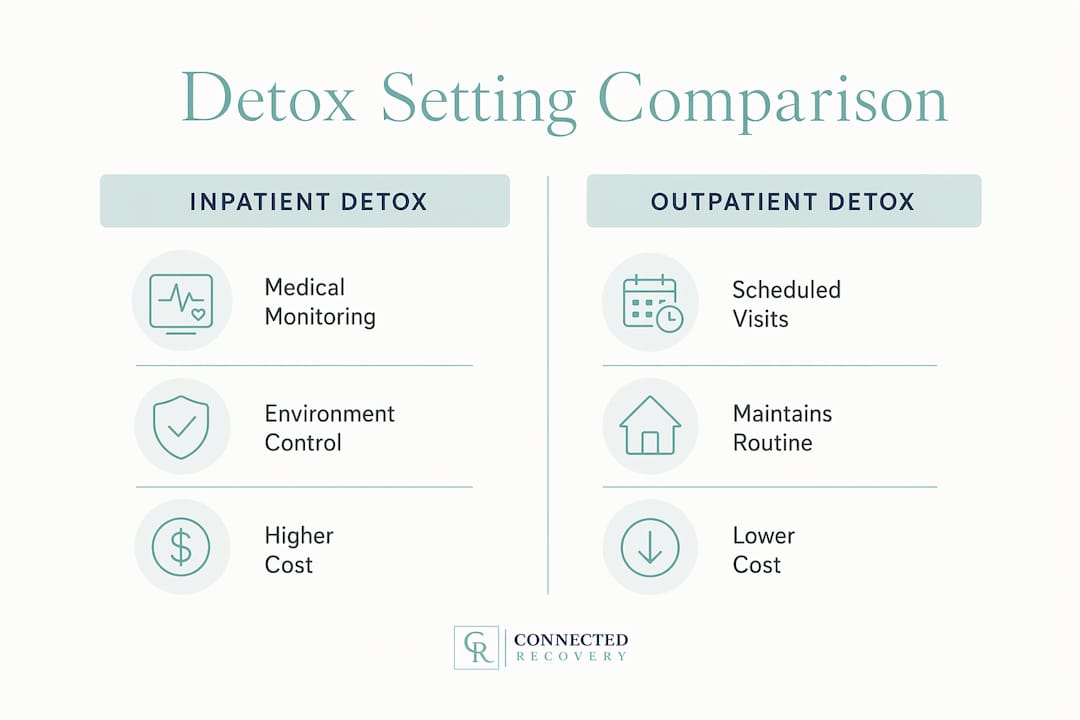
Inpatient advantages: immediate access to emergency intervention, removal from using environment, structured daily routine, higher completion rates for severe cases, direct transition to residential treatment.
Inpatient disadvantages: higher cost, disruption to work and family, separation from home support network, potential stigma around residential admission.
Outpatient advantages: lower cost, less disruption to daily life, maintains family and social connections, greater social support during withdrawal, preferred by many patients.
Outpatient disadvantages: requires reliable self-management between visits, adherence risk, not appropriate for high-severity withdrawal, escalation to inpatient may still be needed.
What are the medical risks, and which medications are used?
Withdrawal from certain substances is genuinely dangerous. Alcohol and benzodiazepine withdrawal can cause seizures and delirium tremens, a syndrome involving severe agitation, hallucinations, fever, and cardiovascular instability that carries a real mortality risk without treatment. Opioid withdrawal is rarely fatal in otherwise healthy adults but causes intense physical distress and carries high overdose risk if the person relapses during or shortly after withdrawal, when tolerance has dropped.
Substances that most commonly require inpatient monitoring:
- Alcohol (especially with prior seizures or DTs)
- Benzodiazepines and other sedative-hypnotics
- Polysubstance dependence involving multiple CNS depressants
The CIWA scale quantifies alcohol withdrawal severity across ten symptom domains. Protocols using CIWA thresholds above 15 for inpatient admission have been shown to reduce unnecessary hospitalizations without increasing readmission rates, meaning the tool works in both directions: it catches people who need inpatient care and identifies those who can safely manage outpatient.
Medication options by substance:
- Alcohol: benzodiazepines remain the gold standard for preventing seizures and delirium; anticonvulsants (gabapentin, carbamazepine) are used as adjuncts or in lower-risk cases
- Opioids: buprenorphine and methadone are evidence-based for opioid withdrawal management; clonidine addresses autonomic symptoms; naltrexone is introduced after full detox
- Stimulants: no FDA-approved withdrawal medication; supportive care and sleep management are primary
- MAT integration: medication-assisted treatment is not just for detox; it should be planned as part of ongoing care from day one of assessment
You can learn more about what medical detoxification involves and how medications are typically sequenced during withdrawal.
Why detox alone is not enough, and how Connected Recovery structures continuity of care
Detox manages the physical withdrawal. It does not treat addiction. That distinction is not semantic. Studies and SAMHSA-commissioned reviews report that only around 15–20% of patients discharged from acute detox go on to receive formal substance use disorder treatment without proactive linkage. The gap between detox completion and sustained recovery is where most people relapse.
Structured linkage to ongoing care, case management, and family involvement are the factors most consistently associated with better post-detox outcomes in systematic reviews. Programs that hand a person a pamphlet at discharge and call it aftercare planning are not meeting that standard.
Connected Recovery structures its care as a continuous sequence rather than a series of disconnected episodes:
- Medical detox: physician-supervised withdrawal management with 24/7 monitoring
- Residential stabilization: a 12-bed residential program that allows individualized attention not possible in larger facilities
- Integrated dual-diagnosis treatment: simultaneous treatment of substance use and co-occurring mental health conditions, not sequential
- Aftercare planning and case management: structured transition planning that begins during detox, not at discharge
The aftercare planning services at Connected Recovery include case management that coordinates the handoff from residential care to outpatient programming, community support, and ongoing monitoring.
Pro Tip: Ask any facility you are considering: “What is your process for linking patients to ongoing treatment after detox?” A vague answer is a red flag. A good program has a specific protocol and can name the resources it uses.
How much does detox cost, and what does insurance typically cover?
Inpatient detox costs more than outpatient, sometimes significantly. The gap reflects the cost of 24/7 staffing, residential accommodations, and the full clinical infrastructure required for continuous monitoring. Geographic market, length of stay, and the level of medical services all affect the final figure.
| Setting | Typical cost range | Key cost drivers |
|---|---|---|
| Inpatient detox | Higher; varies by length of stay and market | 24/7 staffing, residential costs, medication complexity |
| Outpatient detox | Lower; often substantially less than inpatient | Visit frequency, medication costs, program intensity |
Most major commercial insurers cover medically necessary detox under the Mental Health Parity and Addiction Equity Act, which requires comparable coverage for substance use disorders and medical conditions. Medicaid covers detox in most states. Medicare Part A covers inpatient detox when medical necessity criteria are met.
Insurance checklist before admission:
- Confirm whether the facility is in-network for your plan
- Ask whether prior authorization is required and who submits it (the facility should handle this)
- Request the specific medical necessity criteria your insurer uses for inpatient vs outpatient detox
- Ask for a written summary of your benefits for substance use disorder treatment
- Clarify the appeals process if a claim is denied, since initial denials are common and often overturned
The cost difference between settings should not drive the decision when withdrawal severity is high, and it’s important to consider private outpatient wellness services for community-based support like those offered at Kin Wellness. A denied claim can be appealed; a seizure in an unsupervised setting cannot be undone.
How to choose the right detox setting: a practical decision guide
The decision follows a clear sequence when you work through it step by step.
- Get a medical evaluation first. No online quiz or symptom checker replaces a clinical assessment. Call a physician, an addiction specialist, or a facility’s intake line.
- Review your CIWA or clinical assessment results with the clinician. Ask what your score means for level-of-care recommendation.
- Assess your home environment honestly. Is there a responsible adult who can check on you daily? Are substances accessible at home? Is the environment safe?
- Match the level of care to the risk, not the preference. Outpatient is a reasonable choice when safety criteria are met; it is not a reasonable choice when they are not.
Questions to ask any detox facility:
- What is the ratio of nursing staff to patients during overnight hours?
- Is a physician available on-site 24/7, or on call?
- What medications do you use for withdrawal management, and do you offer MAT?
- How do you handle a medical emergency during detox?
- What is your aftercare planning process, and who manages the transition?
- Are you accredited, and by which body?
- Can family members be involved in treatment planning?
A practical checklist of questions to ask detox facilities can help you structure that first call.
Red flags to watch for:
- No physician involvement in withdrawal management
- Vague or dismissive answers about aftercare planning
- Unwillingness to share clinician credentials or accreditation status
- No clear escalation protocol if symptoms worsen
- Pressure to commit before a clinical assessment is completed
Understanding what a safe detox environment looks like in practice helps you evaluate programs before you commit.
Key Takeaways
The core difference between inpatient and outpatient detox is medical monitoring intensity: inpatient provides 24/7 residential supervision, while outpatient relies on scheduled visits and requires a stable home environment to be safe.
| Point | Details |
|---|---|
| Core difference | Inpatient = 24/7 residential monitoring; outpatient = scheduled clinic visits while living at home. |
| Primary decision factor | Withdrawal severity, assessed by CIWA score and clinical history, determines the appropriate setting. |
| Detox is not treatment | Only a minority of patients link to formal substance use disorder treatment after detox without proactive case management. |
| Cost and insurance | Inpatient costs more; both settings are typically covered when medical necessity criteria are met. |
| Connected Recovery | Connected Recovery’s 12-bed residential program links medical detox directly to dual-diagnosis treatment and structured aftercare planning. |
The part most people get wrong about choosing detox
The conventional framing of this decision treats inpatient and outpatient as two equally valid options on a menu, with cost and convenience as the tiebreakers. That framing is wrong, and it leads people to choose outpatient care in situations where it is genuinely unsafe.
The real question is not “which setting do I prefer?” It is “which setting can keep me alive and stable through the worst days of withdrawal?” For someone with a history of alcohol withdrawal seizures, the answer is inpatient, full stop. No amount of motivation, family support, or daily check-in calls changes the physiology of a grand mal seizure in an unsupervised setting.
What gets underestimated is the second half of the equation: what happens after detox. The evidence is consistent that detox completion without planned aftercare rarely leads to sustained recovery. The setting matters less than the continuity. A person who completes inpatient detox and walks out with no follow-up plan is in a worse position than someone who finishes outpatient detox and transitions directly into structured ongoing treatment. The facility’s commitment to that transition, not just the quality of the detox itself, is what should drive the decision.
Connected Recovery’s medical detox and residential programs
Connected Recovery offers a different kind of detox experience than a large hospital unit. With a 12-bed capacity in Van Nuys, CA, the facility provides the kind of individualized attention that gets lost in high-volume settings. Every client receives 24/7 medical supervision, a tailored treatment plan, and a care team that treats substance use and co-occurring mental health conditions together from the start.
The care model runs from medical detox through residential stabilization and into structured aftercare, with case management coordinating each transition. For clients with co-occurring disorders, dual-diagnosis treatment is integrated into the residential program rather than deferred to a later stage. Medication-assisted treatment is available where clinically indicated.
The right level of care is determined by a clinical assessment, not assumed in advance. Contact Connected Recovery to speak with an intake specialist and get a clear picture of which program fits your situation.
This article provides general information about detox settings and is not a substitute for professional medical advice. Please consult a qualified clinician or contact a treatment provider to determine the appropriate level of care for your specific situation.
Useful sources and further reading
- SAMHSA TIP 45: Detoxification and Substance Abuse Treatment — the foundational clinical guidance document establishing that detox is not addiction treatment and outlining evidence-based withdrawal management protocols
- An Overview of Outpatient and Inpatient Detoxification (PMC) — comparative review of detox settings, typical durations, and outcome evidence
- Inpatient and Outpatient Treatment Programs for Substance Use Disorder: A Review of Clinical Effectiveness and Guidelines (NCBI Bookshelf) — systematic review covering comparative effectiveness, medication evidence, and guideline recommendations
- Who Needs Inpatient Detox? Development and Implementation of a Hospitalist Protocol (PMC) — practical CIWA-based triage protocol with outcome data on admission reduction
- SAMHSA — Substance Abuse and Mental Health Services Administration — national resource for treatment locators, clinical guidelines, and policy on substance use disorders
- NIDA — Principles of Drug Addiction Treatment — evidence-based principles covering the role of detox within a broader treatment framework
- Connected Recovery: What Is Medical Detoxification — plain-language guide to the detox process and common medications
- Connected Recovery: Detox Withdrawal Symptoms — What to Expect — symptom-by-symptom overview to help patients and families prepare
- Connected Recovery: Aftercare Planning — details on case management and transition services following detox and residential treatment
Recommended
DHCS Licensed · Joint Commission Accredited
If you or a loved one is struggling with substance use, our admissions team is available to verify your insurance benefits and help you begin recovery. All calls are confidential.